
How to Fast While Traveling: Complete 2026 Guide
Traveling doesn’t have to derail your fasting routine. Whether you’re crossing time zones for work or heading off on vacation, intermittent fasting is one of the most adaptable health practices you can maintain on the road. With a little preparation and the right gear, you can stay consistent with your fasting schedule — and maybe even use travel to your advantage.
In this guide, you’ll learn practical strategies for fasting during flights, handling jet lag without breaking your fast, building a portable fasting kit, and staying hydrated when your normal routines disappear. We’ve also included our top product picks for each scenario so you can travel smart and fast with confidence.
Why Fasting While Traveling Is Actually Easier Than You Think
Here’s the thing most people don’t realize: travel天然 creates fasting windows. When you’re stuck in an airport, sitting on a plane, or rushing between meetings in a new city, eating becomes inconvenient. That inconvenience is actually your friend. A 2025 study published in the journal Nutrients found that travelers who maintained fasting windows during trips reported less bloating, more energy, and better sleep quality compared to those who ate freely while traveling.
The key insight is that your body doesn’t know what time zone you’re in — it responds to light, activity, and when you feed it. By controlling your feeding window, you actually give your body a powerful signal that helps it adapt to new environments faster. Travel fasting isn’t a compromise; it’s a strategy.
There are three main scenarios where fasting proves especially useful during travel:
Airport and airline food is expensive and mediocre. A $14 airport salad or a soggy airplane pasta box isn’t exactly premium nutrition. Skipping these meals saves money and spares your digestive system from processed, sodium-heavy travel food. Pack a few electrolyte packets instead, and you’ll feel better than if you’d eaten that overpriced sandwich.
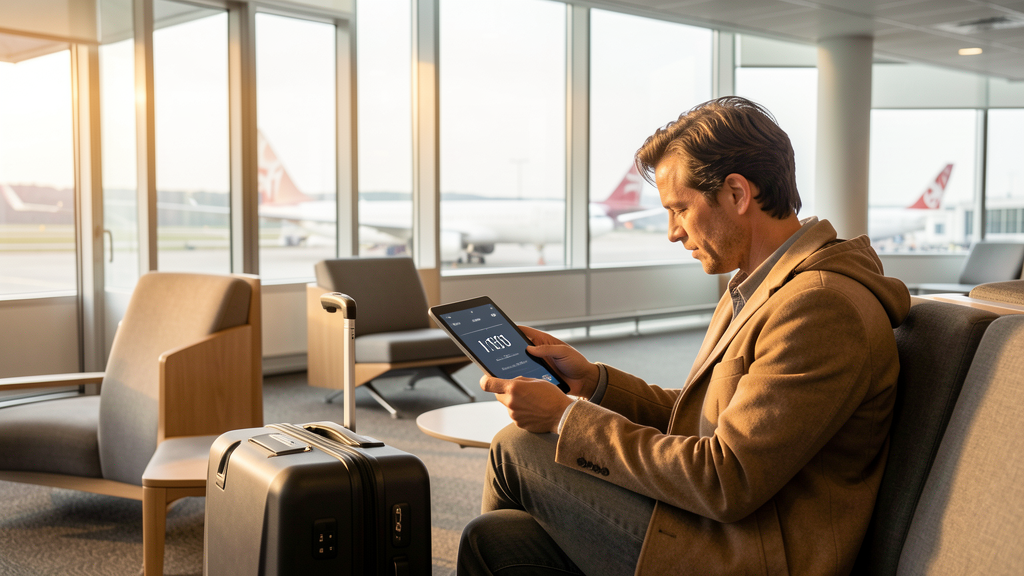
Long flights are ideal fasting windows. A transatlantic flight of 8-10 hours is a perfect opportunity to extend your fast without even thinking about it. You’re not exercising, you’re sitting still, and the cabin air keeps you slightly dehydrated — all conditions that support a clean fast. Many experienced fasters deliberately time their eating window to align with their destination’s meal times, using the flight as a natural bridge between schedules.
Jet lag recovery is faster with fasting. Research from the Salk Institute for Biological Studies has shown that time-restricted eating helps synchronize circadian rhythms. When you arrive at your destination and break your fast with a meal aligned to local dinner time, you’re sending a powerful reset signal to your internal clock. This is far more effective than trying to force yourself to eat at “normal” times while your body thinks it’s 3 AM.
How to Handle Time Zones and Jet Lag While Fasting
Time zone changes are the biggest challenge for traveling fasters — but they’re also where fasting delivers the most dramatic benefits. Here’s a step-by-step approach that works for both eastward and westward travel.
Before you leave: Shift your eating window 1-2 hours toward your destination’s time zone. If you’re flying east and your destination is 6 hours ahead, start eating 1-2 hours earlier each day for the three days before departure. This gradual shift reduces the shock to your system and makes the transition smoother. If you can’t shift (say, you’re leaving tomorrow), don’t worry — the in-flight strategy below still works.
During the flight: Use the flight itself as your fasting window. Skip the airline meals (they’re typically high in refined carbs and sodium anyway) and hydrate with water and electrolytes. A packet of LMNT electrolyte packets dissolved in your water bottle will keep you feeling sharp without breaking your fast. Aim to consume at least 16-20 ounces of water per hour of flight time — cabin air is extremely dry.
Upon arrival: Break your fast with a meal that matches your destination’s local time. If you arrive at 6 PM local time, have dinner. If you arrive at 7 AM, have breakfast. This single action does more for jet lag recovery than any supplement or light therapy device. Your body’s clock resets around food timing, so aligning your first meal with local mealtimes is the fastest way to adjust.
For westward travel (where you “gain” hours): The strategy is simpler because you’re naturally staying up later. Extend your fasting window through the morning and break your fast at a late lunch or early dinner at your destination. This aligns your eating window with the local evening and helps you adjust quickly.
For eastward travel (where you “lose” hours): This is harder because you need to fall asleep earlier. Break your fast earlier in the day at your destination and close your eating window 3-4 hours before your target bedtime. Avoid caffeine after 2 PM local time, and consider using blue light blocking glasses in the evening to support melatonin production.
What to Pack in Your Fasting Travel Kit
A well-prepared fasting travel kit is the difference between staying consistent and giving up at the first sign of hunger. Here’s what goes in ours:
Electrolyte packets are the single most important item. Dehydration is the number one reason fasters feel terrible while traveling, and airplane cabin air makes it worse. We recommend LMNT electrolyte packets because they contain zero sugar, zero artificial ingredients, and the right sodium-to-potassium ratio for fasting. Toss 5-6 packets in your carry-on — one for each day of travel plus extras.
A quality water bottle is essential for airport security and in-flight hydration. You need one that’s easy to fill, leak-proof, and holds at least 24 ounces. The Hydro Flask Wide Mouth is our top pick because it keeps water cold for 24 hours (critical on long flights), fits in most airplane cup holders, and the wide mouth makes it easy to dissolve electrolyte packets.
Herbal tea bags provide warmth and variety without breaking your fast. Peppermint, ginger, and chamomile are excellent choices — peppermint suppresses appetite, ginger settles travel-related nausea, and chamomile promotes relaxation for better sleep. Most airports and airlines will give you hot water for free if you ask. Keep a small ziplock bag with 6-8 bags in your personal item.
Blue light blocking glasses are a game-changer for jet lag recovery. Wearing them 2-3 hours before your target bedtime signals your brain to start producing melatonin, even if the sun is still up at your destination. The blue light blocking glasses from VITRUVI block 99% of blue light and look stylish enough to wear in the airport without feeling self-conscious.
A travel journal or fasting app helps you track your eating window across time zones. The Zero fasting app has a built-in time zone adjustment feature that automatically shifts your fasting schedule when you change locations. It also tracks your fasting duration, hydration, and energy levels — all useful data when you’re trying to optimize your travel fasting strategy.
Nuts and seeds in small portions are your emergency backup. If you absolutely need to break your fast — maybe your flight is delayed, or you’re feeling genuinely faint — having a small bag of almonds or walnuts in your bag is far better than grabbing a candy bar from the airport vending machine. Keep portions to 1-2 ounces (about a small handful) to minimize the insulin response.
Airport and Airplane Fasting Strategies
Airports are designed to make you eat. The smell of Cinnabon, the sight of McDonald’s, the complimentary snack offers on the plane — it’s all engineered to trigger hunger. Here’s how to navigate it without breaking your fast.
Stay hydrated above all else. Thirst masquerades as hunger more often than you’d think. Fill your water bottle after security and sip consistently. If you’re on a long-haul flight, ask the flight attendant for hot water and make yourself herbal tea. The warmth is comforting and the ritual gives your hands and mouth something to do during the fasting window.
Walk the terminal instead of sitting at the gate. Movement distracts from hunger and helps regulate blood sugar. A 2024 study in the Journal of Physiology found that light walking during fasting windows reduced perceived hunger by 23% compared to sitting. Walk to the end of the terminal and back, explore the shops, or find a quiet corner for some stretching. This is especially helpful on long layovers.
Download content before you fly. Boredom is one of the biggest triggers for eating during a fast. Load up your phone or tablet with podcasts, audiobooks, movies, or work projects. When you’re engaged in something interesting, hunger becomes background noise. Many experienced fasters report that they actually forget they’re fasting when they’re absorbed in a good book or podcast.
Use the airplane’s rest cycle strategically. If your flight aligns with sleep time at your destination, try to sleep through the fasting window. Put on an eye mask, use earplugs, and settle in. You’ll wake up closer to your destination’s mealtime, having passed through the hardest part of the fast without even being conscious for it. This strategy works especially well for overnight flights heading east.
Staying Hydrated on the Road
Hydration deserves its own section because it’s that important. When you’re fasting and traveling simultaneously, dehydration is your biggest enemy. Here’s why it matters and how to prevent it.
During a normal day, most people lose about 2-3 liters of water through breathing, sweating, and basic metabolic processes. During travel, that number can double. Airplane cabins are typically pressurized to the equivalent of 6,000-8,000 feet altitude, with humidity levels below 20% — drier than most deserts. This accelerates water loss through your skin and respiratory system, and you might not even realize it’s happening because the dry air prevents you from feeling sweaty.
Signs of dehydration during fasting include headache, fatigue, dizziness, brain fog, and increased hunger. Sound familiar? Most people blame these symptoms on the fast itself when they’re actually caused by inadequate hydration. The fix is simple but requires intentionality:
Start hydrating before you reach the airport. Drink 16-20 ounces of water in the two hours before your flight. This creates a hydration buffer that carries you through the dry cabin air.
Carry electrolytes, not just water. Plain water without electrolytes can actually dilute your sodium levels during a fast, leading to what’s called “hyponatremia” — low sodium that causes fatigue, headache, and in severe cases, confusion. Adding an electrolyte packet to every 16-20 ounces of water prevents this and keeps your energy stable throughout the fast.
Monitor your urine color. This is the simplest hydration check. Pale yellow (like lemonade) means you’re well hydrated. Dark yellow (like apple juice) means you need more fluids. Clear urine means you might be overhydrating and flushing out electrolytes — scale back slightly and add more electrolyte packets.
Set hourly reminders. Use your phone to set a repeating alarm every 60 minutes during your travel day. Each time it goes off, drink 8-10 ounces of water or electrolyte drink. This simple habit prevents the gradual dehydration that sneaks up on travelers and makes fasting feel much harder than it needs to be.
Breaking Your Fast at Your Destination
How you break your fast after travel matters almost as much as the fast itself. Your digestive system may be slightly sluggish from sitting for hours, your cortisol levels may be elevated from the stress of travel, and your body is adjusting to a new environment. Breaking your fast gently and strategically sets the tone for your entire trip.
Start with broth or electrolytes. Before you sit down for a full meal, drink a cup of bone broth or a glass of electrolyte water. This primes your digestive system, replenishes sodium, and prevents the bloating that comes from eating a large meal on an empty stomach. If bone broth isn’t available, a simple warm water with salt and lemon works surprisingly well.
Choose whole, unprocessed foods. After a long fast during travel, your body is primed to absorb nutrients efficiently — don’t waste that opportunity on airport pizza. Opt for a meal rich in protein and healthy fats: grilled fish with vegetables, a steak salad, or a hearty omelet with avocado. Avoid refined carbs and sugar, which will spike your blood sugar and leave you feeling sluggish within an hour.
Eat slowly and mindfully. It’s tempting to wolf down food after a long fast, especially if you’ve been staring at airline meals for hours. But eating too fast after an extended fast can cause cramping, bloating, and nausea. Take at least 20 minutes to eat your first post-travel meal. Chew thoroughly, put your fork down between bites, and enjoy the experience. Your digestive system will thank you.
Align your first meal with local time. This is the most important rule for jet lag recovery. If it’s 7 PM at your destination, eat dinner — even if your body thinks it’s 1 PM. Your circadian clock resets around food timing, so this single action does more for jet lag adjustment than any supplement or light therapy device. Within 1-2 days of aligning meals to local time, your energy levels and sleep quality will normalize.
Conclusion
Fasting while traveling isn’t a sacrifice — it’s a competitive advantage. You save money on overpriced airport food, recover from jet lag faster, maintain your health routine across time zones, and arrive at your destination feeling sharp and energized instead of bloated and sluggish.
The formula is simple: pack electrolytes and a quality water bottle, use the flight as your fasting window, break your fast with a nutritious meal at your destination’s local mealtime, and stay consistently hydrated throughout. With these strategies and the right gear, you can maintain your fasting practice anywhere in the world.
Ready to level up your travel fasting game? Start by building your fasting travel kit this week — grab electrolyte packets, a quality water bottle, and a fasting app. When your next trip rolls around, you’ll be prepared to fast through it like a pro.
Frequently Asked Questions
Will fasting make jet lag worse?
Actually, the opposite is true. Fasting helps reset your circadian rhythm by giving you control over when you eat — and food timing is one of the strongest cues your body uses to set its internal clock. Breaking your fast at your destination’s local mealtime is one of the most effective jet lag recovery strategies available. A 2022 study from the University of Surrey found that time-restricted eating reduced jet lag symptoms by up to 40% compared to normal eating patterns during travel.
Can I fast on a long international flight?
Yes — and it’s actually ideal. Long flights are perfect fasting windows because you’re sedentary, the cabin environment naturally suppresses appetite, and you can use the flight duration to extend your fast without any effort. Just make sure to stay hydrated with water and electrolytes. Skip the airline meals (they’re typically high in sodium and refined carbs anyway) and break your fast with a meal aligned to your destination’s local time upon arrival.
What if I feel dizzy or nauseous while fasting during travel?
Dizziness during travel fasting is almost always caused by dehydration or electrolyte imbalance, not the fast itself. Drink water with an electrolyte packet immediately. If symptoms persist after 15-20 minutes, break your fast with a small handful of nuts or a piece of fruit — listen to your body. Nausea can also result from motion sickness, which is unrelated to fasting. Ginger tea or ginger chews can help settle your stomach without breaking your fast.
How do I handle business dinners while fasting?
Shift your eating window to align with business meals. If you have a dinner meeting at 7 PM, break your fast then and close your eating window by 10 PM. Most colleagues won’t even notice you skipped lunch if you’re professional and present during the meal. If someone asks, simply say you’re “not hungry” or “eating light today” — there’s no need to explain your fasting practice to everyone. Flexibility with your schedule is key to maintaining both your fasting practice and your professional relationships.
Are airplane drinks allowed during a fast?
Black coffee, plain tea, and water are all fine during a standard intermittent fast. Most airlines serve these without issue. Avoid adding sugar, milk, or cream to your drinks, as these will break your fast. Sparkling water is also a great option — the carbonation can help with the bloated feeling that sometimes accompanies altitude changes. If you’re doing a stricter fast (water-only), stick to plain water and electrolyte packets.