

Why Your Ketone Strips Show Lower Levels the Longer You Fast
If you’ve been testing your ketones during an extended fast and noticed the readings dropping after a few days, you’re not alone. It’s one of the most common questions in fasting communities: “Why are my urine ketone strips reading lower and lower the longer my fast goes on?”
The short answer: your body has become more efficient at using ketones, so fewer are wasted in urine. The long answer involves understanding the three different types of ketone testing — and which one actually tells you what’s happening during your fast.
In this guide, we’ll break down the science of ketone production during fasting, explain why each testing method gives different results, and help you choose the right tools to accurately track your fasting ketosis. Check the latest blood ketone meters on Amazon →
The Three Types of Ketones (And Why It Matters for Testing)
Your liver produces three types of ketone bodies during fasting:
- Acetoacetate (AcAc) — the “parent” ketone that appears in urine
- Beta-hydroxybutyrate (BHB) — the most abundant ketone in your bloodstream, and the one your brain and muscles actually use for fuel
- Acetone — a byproduct of acetoacetate breakdown, detectable on your breath
Here’s the critical insight: different ketone testing methods measure different ketones. Urine strips measure acetoacetate, blood meters measure BHB, and breath analyzers measure acetone. That’s why your readings can look contradictory depending on which method you use.
During the first 2-3 days of a fast, your body is new to ketosis. It produces more ketones than it can use, and the excess acetoacetate spills into your urine. That’s why urine strips show high readings early in your fast. But as your body adapts — typically by days 3-5 — your muscles and other tissues switch to using fatty acids directly, reserving ketones primarily for your brain. Less acetoacetate is wasted in urine, and your strips show “lower” ketosis even though you’re actually in deeper ketosis than before.
Urine Ketone Strips: Cheap but Misleading for Fasters
Urine ketone test strips are the most popular and affordable way to check for ketosis. They cost around $8-15 for 100-200 strips and give results in under a minute. But they have significant limitations for fasters:
When urine strips work well:
- Confirming you’ve entered ketosis (day 1-3 of a fast)
- Quick, cheap daily checks for intermittent fasters
- Testing after meals to see if you’ve been kicked out of ketosis
When urine strips fail fasters:
- After day 3-5 of extended fasting (readings drop as you adapt)
- Measuring how deep your ketosis actually is
- Tracking ketone levels during exercise (dehydration concentrates urine)
- If you’re drinking very large amounts of water (dilutes readings)
The biggest mistake fasters make is seeing a drop in urine ketone readings and thinking they’re “doing something wrong.” In reality, a declining urine ketone reading during an extended fast is a sign of metabolic adaptation — your body is becoming more efficient at using ketones for fuel rather than wasting them. This is exactly what you want to happen.
Bottom line: Urine strips are great for confirming “Am I in ketosis?” during the first few days. They are not reliable for tracking ketone levels during longer fasts.
Blood Ketone Meters: The Gold Standard for Fasting Ketosis
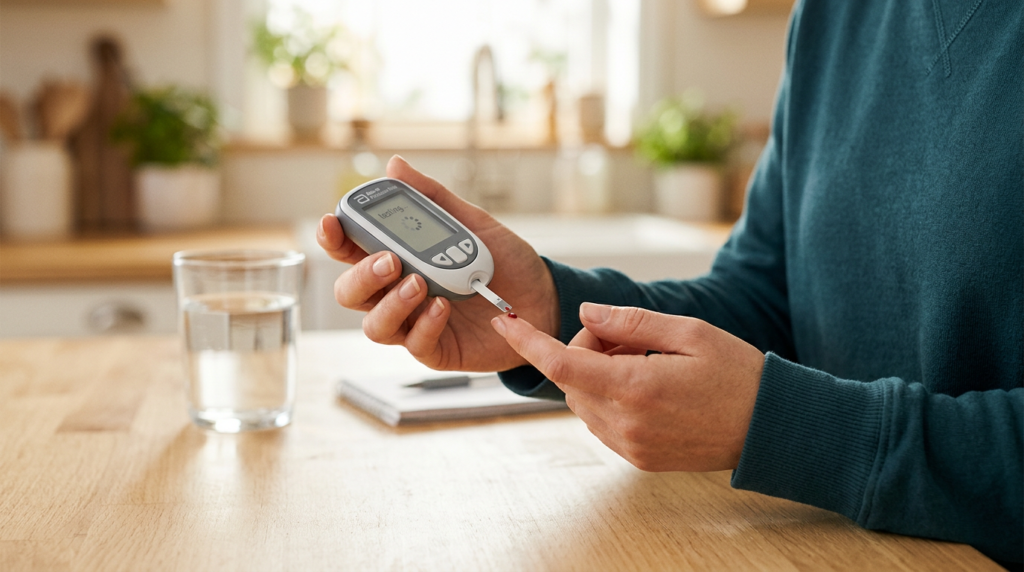
If you want accurate, reliable ketone readings throughout your entire fast, a blood ketone meter is your best option. These devices measure beta-hydroxybutyrate (BHB) — the ketone that actually fuels your brain during fasting.
How blood ketone testing works:
You prick your finger with a lancet, apply a drop of blood to a specialized test strip, and the meter gives you a reading in mmol/L within seconds. Nutritional ketosis is typically defined as 0.5-3.0 mmol/L BHB. During extended fasting, readings of 3.0-5.0+ mmol/L are common.
Advantages for fasters:
- Most accurate — measures the actual ketone your body uses for fuel
- Works throughout your entire fast — unlike urine strips, readings don’t drop as you adapt
- Not affected by hydration — blood concentration is stable regardless of water intake
- Quantitative — gives exact mmol/L readings you can track over time
The main drawback:
Test strips are expensive — typically $1-3 per strip. At 2-4 tests per day during an extended fast, costs add up quickly. However, for the accuracy and reliability you get, many experienced fasters consider it worth the investment.
Tip: Test fasting ketones first thing in the morning before eating or drinking, and again in the evening. These two time points give you a reliable picture of your ketone trajectory without burning through strips unnecessarily.
Breath Ketone Monitors: Reusable but Less Precise
Breath ketone analyzers measure acetone on your breath — a byproduct of fat metabolism. The biggest advantage is that breath ketone monitors require no consumable strips, making them essentially free to use after the initial purchase ($30-60 for basic models, $150+ for clinical-grade devices like the Ketonix).
How breath testing works during fasting:
You exhale into the device, and it measures acetone concentration. Higher acetone = more fat oxidation = deeper ketosis. Some devices give simple color indicators (green/yellow/red), while others provide numerical readings.
Advantages for fasters:
- No ongoing costs — no strips or consumables needed
- Non-invasive — no finger pricks
- Track trends over time — useful for seeing whether ketosis is increasing or decreasing
- Test as often as you want — since each test is free
Limitations:
- Less precise than blood testing — acetone levels don’t perfectly correlate with blood BHB
- Affected by alcohol — mouthwash, hand sanitizer, and alcohol consumption can interfere
- Requires calibration — some devices need regular recalibration
- Not great for absolute values — better for tracking relative changes than exact ketone levels
Best use case: Breath monitors are ideal for intermittent fasters who want to check ketosis daily without the cost of blood strips. They’re also great for extended fasters who want unlimited testing between blood ketone checks.
Which Ketone Testing Method Should You Use During Fasting?
| Method | Best For | Cost Per Test | Accuracy During Extended Fasts |
|---|---|---|---|
| Urine strips | Confirming initial ketosis (days 1-3) | $0.05-0.15 | Low (readings drop after adaptation) |
| Blood meter | Accurate tracking throughout entire fast | $1-3 | High (most reliable method) |
| Breath analyzer | Daily trend monitoring, unlimited testing | $0 (after purchase) | Medium (good for trends, not exact values) |
For most fasters, the ideal setup combines two methods: urine strips for quick initial confirmation (those first 2-3 days), then switching to a blood ketone meter for accurate readings during the rest of your fast. Add a breath analyzer if you want unlimited daily testing without ongoing strip costs.
What Your Ketone Levels Should Look Like During a Fast
Using blood BHB measurements (the most accurate method), here’s what typical ketone progression looks like during a water fast:
Hours 0-12: Transition Phase
Your body is depleting glycogen stores. Blood ketones may be near zero (0.0-0.2 mmol/L). You’re not yet in ketosis.
Hours 12-24: Early Ketosis
Glycogen is running low, and your liver begins ramping up ketone production. Readings typically reach 0.3-0.8 mmol/L. Urine strips may start showing trace ketones.
Hours 24-48: Nutritional Ketosis
Your body is now primarily running on ketones and fatty acids. Blood BHB readings commonly reach 1.0-2.5 mmol/L. This is where many of the benefits of fasting — mental clarity, appetite suppression, fat burning — become noticeable.
Hours 48-72: Deepening Ketosis
Ketone production continues to increase as your body becomes more efficient. Readings of 2.0-4.0 mmol/L are common. Urine ketone strips may paradoxically decrease during this phase as your kidneys reabsorb ketones rather than excreting them.
Days 4+: Adapted Ketosis
Your body has fully adapted to fat-burning mode. Blood ketones may stabilize between 3.0-6.0 mmol/L. You feel energized and clear-headed. Urine strips typically show their lowest readings of the entire fast, even though you’re in your deepest ketosis.
Key takeaway: If your urine strips are dropping but you feel great, your blood ketones are likely high, and your body is simply using ketones efficiently. Don’t let declining urine readings make you doubt your fast.
Common Ketone Testing Mistakes Fasters Make
1. Trusting urine strips after day 3
This is by far the most common mistake. Seeing lower urine ketone readings and assuming your fast isn’t working. In fact, it means your body is adapting perfectly.
2. Testing at inconsistent times
Ketone levels fluctuate throughout the day. Morning readings are typically highest after overnight fasting. Testing at random times makes it impossible to track meaningful trends. Pick 2-3 consistent testing times and stick with them.
3. Comparing different testing methods
Don’t compare urine strip colors to blood meter readings to breath analyzer numbers. Each measures a different ketone. Track trends within the same method for consistent data.
4. Obsessing over exact numbers
Ketone levels are just one data point. How you feel, your energy levels, sleep quality, and weight loss progress matter more than hitting a specific mmol/L target. More ketones doesn’t automatically mean more fat loss.
5. Not accounting for electrolytes and hydration
Dehydration concentrates blood and can temporarily inflate blood ketone readings. Excessive water intake dilutes urine and can lower urine strip readings. Stay consistently hydrated and factor this into your readings.
Should You Use a CGM Alongside Ketone Testing?
A continuous glucose monitor (CGM) adds another dimension to your fasting data by tracking blood glucose in real time. While CGMs don’t measure ketones directly, watching your glucose drop and stabilize during a fast provides valuable context for your ketone readings.
For example, if your blood glucose drops below 60 mg/dL but your ketones are at 3.0+ mmol/L, you know your body has successfully switched to fat-burning mode and your brain is well-fueled by ketones. If glucose is low but ketones are also low, that might indicate you need more time to adapt or that something is off.
Combined glucose + ketone tracking is the most comprehensive way to monitor your fasting metabolic state. For a deeper dive, check out our complete guide to the best CGMs for fasting.
Conclusion
Declining ketone strip readings during an extended fast isn’t a problem — it’s proof that your body has become metabolically flexible. Your muscles and kidneys are conserving ketones because your body has learned to use them efficiently.
For the most accurate ketone tracking during fasting, invest in a blood ketone meter and use urine strips only for that initial “Am I in ketosis yet?” confirmation during the first few days. If you want unlimited daily testing, a breath analyzer gives you trend data without ongoing costs.
The best testing method is the one you’ll actually use consistently. Start simple, track trends rather than obsessing over absolute numbers, and remember: how you feel during your fast matters far more than what any meter tells you.
As an Amazon Associate, I earn from qualifying purchases.
Frequently Asked Questions
Why are my ketone strips getting lighter the longer I fast?
Your body becomes more efficient at using ketones as your fast progresses. Instead of excreting excess acetoacetate in urine, your kidneys reabsorb it and your muscles use fatty acids directly, reserving ketones for your brain. Lower urine readings actually indicate better metabolic adaptation.
What’s the most accurate way to test ketones during an extended fast?
A blood ketone meter measuring beta-hydroxybutyrate (BHB) is the most accurate method. Unlike urine strips, blood BHB readings remain reliable throughout your entire fast because they measure the ketone your body actually uses for fuel, not the waste product.
Can I use a breath ketone monitor instead of blood testing?
Yes, breath monitors work well for tracking ketone trends over time and are free to use after the initial purchase. However, they’re less precise than blood meters for exact ketone levels. Many fasters use both: breath for daily trend checks and blood for precise measurements at key intervals.
What blood ketone level should I aim for during a fast?
During extended fasting, blood BHB levels of 1.5-5.0 mmol/L are typical and healthy. There’s no “target” number — your body will naturally regulate ketone production based on its needs. More ketones doesn’t necessarily mean more fat loss or better results.
Do I need to test ketones at all during my fast?
Not necessarily. Many experienced fasters don’t test at all and simply go by how they feel. Ketone testing can be helpful for beginners who want confirmation that they’re in ketosis, or for data-driven fasters who enjoy tracking their metabolic state. It’s optional, not required.