
Creatine vs BCAAs for Fasting: Muscle Guide 2026
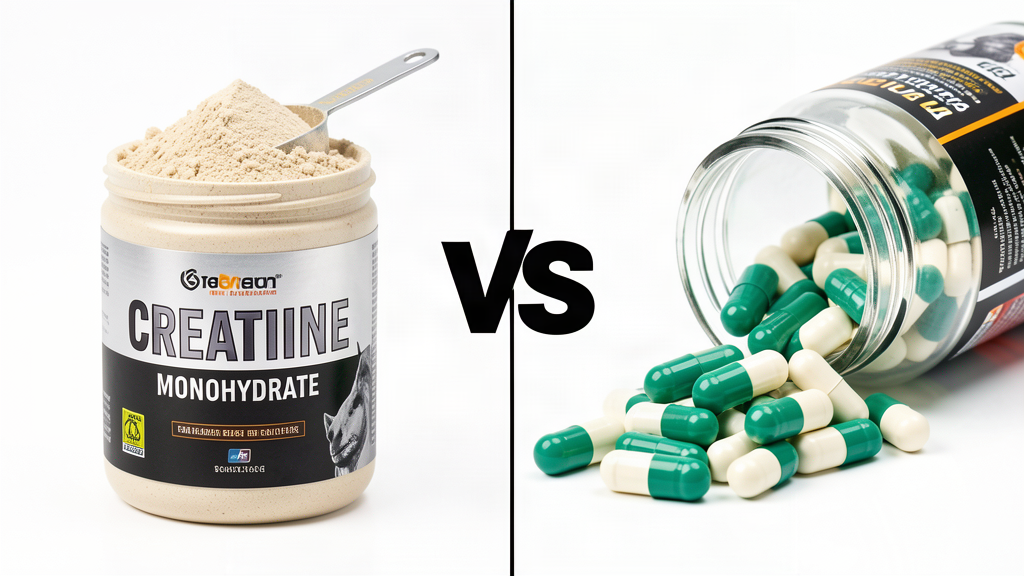
If you train fasted — or even just workout after a long overnight fast — you’ve probably wondered whether creatine or BCAAs is the better supplement to protect your hard-earned muscle. Both are marketed aggressively to fitness enthusiasts, but they work through fundamentally different mechanisms, and the science behind each tells a very different story when fasting is involved.
In this comparison, we break down how creatine and BCAAs perform across five critical categories for fasting athletes: muscle preservation during caloric restriction, autophagy compatibility, insulin response, practical dosing, and long-term evidence. By the end, you’ll know exactly which supplement deserves a spot in your fasting routine — and which one might actually be working against your goals.
Quick Comparison: Creatine vs BCAAs at a Glance
| Feature | Creatine Monohydrate | BCAAs |
|---|---|---|
| Calories per serving | 0 | ~20-40 kcal |
| Breaks a fast? | No | Technically yes |
| Insulin response | None or negligible | Leucine triggers insulin |
| Muscle preservation | Strong evidence | Mixed — ineffective if protein is adequate |
| Autophagy impact | No disruption | Amino acids suppress autophagy |
| Brain benefits | Yes (cognitive support) | Minimal |
| Typical daily dose | 3-5 g | 5-15 g (split doses) |
| Cost per month | $10-15 | $20-40 |
| Scientific evidence | 30+ years of research | Limited — no edge over complete protein |
The table tells the story, but the details matter. Let’s dig into each category so you can make an informed choice.
Muscle Preservation During Fasted Training
The primary reason fasting athletes reach for supplements is muscle preservation. When you train in a fasted state, your body has less circulating amino acids to fuel muscle protein synthesis (MPS). This creates a catabolic environment that, left unchecked, leads to muscle loss over time. Both creatine and BCAAs claim to solve this problem — but the evidence strongly favors one.
Creatine’s Muscle-Sparing Mechanism
Creatine monohydrate works by increasing phosphocreatine stores in your muscles. During high-intensity exercise, your body draws on phosphocreatine to regenerate ATP — the primary energy currency of your cells. More available ATP means you can train harder and longer, which directly translates to a stronger muscle-building signal even when food intake is limited.
A 2026 study published in the journal Nutrients found that creatine supplementation preserved lean mass during caloric deficits, particularly when combined with resistance training. Participants taking 5g of creatine daily while in a 500-calorie deficit maintained significantly more muscle than the placebo group. The mechanism isn’t just about energy — creatine also increases cell hydration, which triggers anabolic signaling pathways independent of food intake.
For fasting athletes, this is the critical advantage: creatine supports your training quality and muscle signaling without requiring calories, protein, or any break in your fast.
BCAAs: The Incomplete Protein Problem
BCAAs (branched-chain amino acids) — leucine, isoleucine, and valine — are marketed as a way to stimulate muscle protein synthesis during fasting. The logic is straightforward: if your body lacks amino acids during a fast, providing the three most anabolic BCAAs should protect muscle. The theory is elegant. The science is not.
Multiple systematic reviews, including a comprehensive 2024 meta-analysis in the Journal of the International Society of Sports Nutrition, have concluded that BCAAs provide no additional muscle-building benefit when total daily protein intake is adequate (0.8-1.0 g per pound of body weight). Your muscles need all 20 amino acids to build tissue — BCAAs alone are like trying to build a house with only bricks, no mortar or windows.
More critically for fasting athletes: BCAAs contain calories. Even small amounts of amino acids can shift your metabolism out of the fasted state. Leucine, the most anabolic BCAA, directly activates mTOR — the master regulator of cell growth. While mTOR activation sounds good for muscle building, it simultaneously suppresses autophagy, the cellular cleanup process that many people fast specifically to activate.
Autophagy and Fasting Compatibility
Many fasting practitioners aren’t just interested in weight loss or muscle preservation — they fast specifically to activate autophagy, the body’s process of cleaning out damaged cells and recycling cellular components. Autophagy is regulated by two opposing pathways: mTOR (growth) and AMPK (energy conservation). When you eat, mTOR activates and autophagy pauses. When you fast, AMPK activates and autophagy increases.
Why Creatine Doesn’t Interfere
Creatine monohydrate has zero calories and does not trigger an insulin or mTOR response. It enters muscle cells through a sodium-dependent transporter, bypassing the digestive triggers that would otherwise signal your body that food has arrived. This means you can take creatine during your fasting window without interrupting autophagy.
This is a significant advantage for practitioners of extended fasts (24-72+ hours) who want both muscle protection and autophagy activation. Taking 3-5g of creatine with water during a long fast gives you the best of both worlds.
Why BCAAs Interrupt Autophagy
BCAAs, by contrast, are amino acids — and amino acids are one of the most potent activators of mTOR. Leucine in particular is considered the “trigger” for mTOR activation. Even a modest dose of 5g of BCAAs delivers enough leucine to activate this pathway, effectively pausing autophagy.
For someone fasting primarily for autophagy benefits (longevity, cellular repair, neuroprotection), taking BCAAs during the fasting window undermines the core purpose of the fast. It’s the equivalent of opening the oven door while baking — you don’t lose all the heat, but you significantly slow the process.
Recovery and Performance During Fasted Training
Beyond muscle preservation, both supplements claim to improve workout performance and recovery. Here’s where the evidence diverges most sharply.
Creatine: Proven Performance Benefits
Creatine is the single most studied sports supplement in history, with over 30 years of peer-reviewed research. The evidence consistently shows:
- Strength gains: 5-15% increase in maximal strength across multiple studies
- Power output: Significant improvement in explosive movements (sprints, jumps)
- Training volume: More reps and sets before fatigue
- Recovery: Reduced muscle damage markers after intense exercise
- Brain health: Emerging evidence for cognitive benefits, mood support, and neuroprotection
For fasting athletes specifically, a 2025 study found that creatine supplementation during intermittent fasting improved high-intensity interval training (HIIT) performance by 8% compared to fasting alone. The participants maintained their lean mass over 12 weeks while losing body fat — a body recomposition outcome that’s notoriously difficult during caloric restriction.
BCAAs: The Evidence Gap
BCAAs have a much thinner evidence base. The core problem is that most BCAA studies compared supplementation to inadequate protein intake. When researchers controlled for total protein, BCAAs showed no additional benefit for muscle growth or recovery.
A frequently cited 2017 study in the Journal of the International Society of Sports Nutrition directly compared BCAAs to whey protein and found that whey — a complete protein containing all essential amino acids — was significantly superior for muscle protein synthesis. BCAAs provided roughly 22% less MPS stimulation than whey.
For fasting athletes, this raises a practical question: if you’re going to break your fast with a supplement, why choose BCAAs (incomplete, calorie-containing, mTOR-activating) over a complete protein shake or a whole-food meal? BCAAs occupy an awkward middle ground — they break your fast less thoroughly than a full meal, but they break it more than creatine, and they’re less effective than either option at actually building muscle.
When to Use Creatine vs BCAAs for Fasting
The evidence points clearly toward creatine for most fasting scenarios, but BCAAs do have narrow use cases where they might make sense. Here’s a practical decision framework:
Choose Creatine When:
- You train fasted and want to preserve muscle without breaking your fast
- You practice extended fasts (24+ hours) and want autophagy benefits alongside muscle protection
- You want brain health and cognitive benefits during fasting (especially during prolonged caloric restriction)
- You’re on a budget — creatine costs roughly $10-15/month vs $20-40/month for BCAAs
- You want the strongest evidence-backed supplement available
Consider BCAAs (Briefly) When:
- You’re doing extremely long fasts (72+ hours) with no protein at all and want minimal amino acid supplementation — though even here, a small amount of whey isolate is generally superior
- You have specific amino acid deficiencies confirmed by bloodwork
- You’re already taking creatine and want a secondary supplement for variety
For the vast majority of fasting athletes — whether you’re doing 16:8 intermittent fasting, OMAD, or extended multi-day fasts — creatine monohydrate is the clear winner. It protects your muscles, supports your training, doesn’t break your fast, and costs a fraction of what BCAAs cost.
How to Take Creatine While Fasting
Timing matters less with creatine than you might think. Creatine works by saturating your muscle stores over time — it’s not an acute supplement like caffeine. Once your stores are full (typically after 2-4 weeks of consistent daily dosing), timing becomes largely irrelevant.
For fasting athletes, the most practical approach:
- Take 3-5g daily — with water, during your eating window or fasting window, it doesn’t matter
- Consistency is key — miss a day and your stores start to deplete (slowly)
- No loading phase needed — the old “20g/day for a week” loading protocol is unnecessary and can cause stomach discomfort
- Pair with water — creatine draws water into muscle cells; stay hydrated
- Take with food if sensitive — some people get mild stomach upset taking creatine on an empty stomach; if so, take it during your eating window
One important note: creatine will cause the scale to go up 2-4 pounds in the first few weeks. This is water weight being pulled into your muscles — it’s not fat gain. If you’re tracking weight during a fasting protocol, expect this bump and don’t panic.
Our Top Pick for Fasting Athletes
If you’re training fasted and want to preserve muscle without breaking your fast, creatine monohydrate is the clear winner. We recommend starting with 5g daily for the first month, then dropping to 3g for maintenance. Check the latest price on Amazon — it’s one of the most affordable and effective supplements you can add to your fasting routine.
Frequently Asked Questions
Does creatine break a fast?
No. Creatine monohydrate has zero calories, no carbohydrates, no protein, and no insulin response. You can take it during your fasting window without interrupting ketosis or autophagy. It enters muscle cells through a sodium-dependent transporter, completely bypassing the metabolic pathways that would signal your body that food has arrived.
Do BCAAs break a fast?
Technically, yes. BCAAs contain calories (roughly 4.5 kcal per gram) and the leucine in BCAAs activates mTOR, which is the pathway that pauses autophagy. For strict fasts focused on autophagy, even a 5g dose of BCAAs will partially interrupt the process. For weight-loss-focused fasts, the impact is minimal — but it’s still more disruptive than creatine.
Can I take creatine and BCAAs together while fasting?
You can, but there’s little reason to add BCAAs if you’re already taking creatine. Creatine protects your training performance and muscle stores independently. BCAAs add calories and mTOR activation without meaningful additional muscle-building benefit. If you do combine them, take creatine during your fast and BCAAs only during your eating window to preserve autophagy benefits.
How much creatine should I take during a fasting protocol?
3-5 grams daily is the standard dose for most adults. No loading phase is required — just take it consistently every day. Your muscle stores will reach saturation in 2-4 weeks at this dose. For extended fasts, you can take your daily dose at any time; the accumulation effect means timing is not critical.
Will creatine cause bloating while fasting?
Initial water retention (2-4 pounds) is normal as creatine pulls water into muscle cells. This is not bloating — it’s intracellular hydration that actually supports muscle function. Some people experience mild stomach discomfort if taking creatine on a completely empty stomach. If this happens, move your dose to your eating window. The performance and muscle benefits are identical either way.
As an Amazon Associate, I earn from qualifying purchases.
Bottom line: For fasting athletes who want to preserve muscle, maintain training quality, and support autophagy, creatine monohydrate is the evidence-based choice. It’s cheaper, more effective, and doesn’t interfere with your fast. BCAAs had their moment, but the science has moved on — and so should your supplement stack.
Related posts:
 Fasting And Muscle Preservation: How To Maintain Muscle Mass
 Best Supplements for Fasting and Muscle Preservation in 2026
 Unleashing Your Potential: A Comprehensive Look at Nutricost Creatine Monohydrate Micronized Powder
 Unlocking Peak Performance: The Benefits of Optimum Nutrition Micronized Creatine Monohydrate Powder
 Does Fasting Cause Muscle Loss? The Science (2026)