
Fasting and Cancer: The MIT Stem Cell Study Explained
When the MIT study on fasting and intestinal stem cells hit the news, fasting forums split in half overnight. One side called it proof that fasting rebuilds the body from the cellular level up. The other side read the headlines as a warning that every fast quietly raises your cancer risk. Neither camp had it quite right. The real findings, published in the journal Nature by biologist Omer Yilmaz and his team at MIT, are more interesting than either the hype or the panic — and understanding them changes how you should break your next fast.
In this guide, we unpack exactly what the MIT researchers found in mice, how it connects to their earlier discovery that a 24-hour fast supercharges gut stem cells, why the refeeding window is the part that matters, and what all of it actually means for your fasting practice in 2026. Along the way, you will find the foods and supplements that support a cleaner refeed, plus the human evidence that keeps the picture balanced.
What the MIT Study Actually Found
In August 2024, the Yilmaz lab at MIT published a study in Nature that set off a firestorm of half-true headlines. The design was straightforward. Researchers placed mice into three groups: one group fasted for 24 hours, a second group fasted for 24 hours and then ate freely for the next 24 hours, and a control group ate whenever it wanted. Then they examined the intestinal stem cells — the master cells responsible for constantly rebuilding the gut lining.
The results had two halves. During the fasting period, stem cell activity was actually suppressed. The gut was quiet. But during the refeeding period, something dramatic happened: stem cell proliferation surged, climbing even higher than the levels seen in mice that had never fasted at all. The fast had primed the cells for a massive burst of regeneration the moment food returned.
Here is the catch that generated the scary headlines. When the researchers introduced a cancer-causing mutation during that high-proliferation refeeding window, the mice were significantly more likely to develop early-stage intestinal tumors than mice that had not fasted. Rapid cell division is exactly the environment in which mutations spread, because every round of division is a chance for errors to copy themselves forward.
Senior author Omer Yilmaz summarized the tension in a single line: having more stem cell activity is good for regeneration, but too much of a good thing over time can have less favorable consequences. And a critical nuance got buried in the coverage: the tumor risk appeared only in combination with a pre-existing, defined cancer-initiating mutation. Fasting did not create the mutation. It amplified what was already there.
How Fasting Rebuilds Your Gut Lining
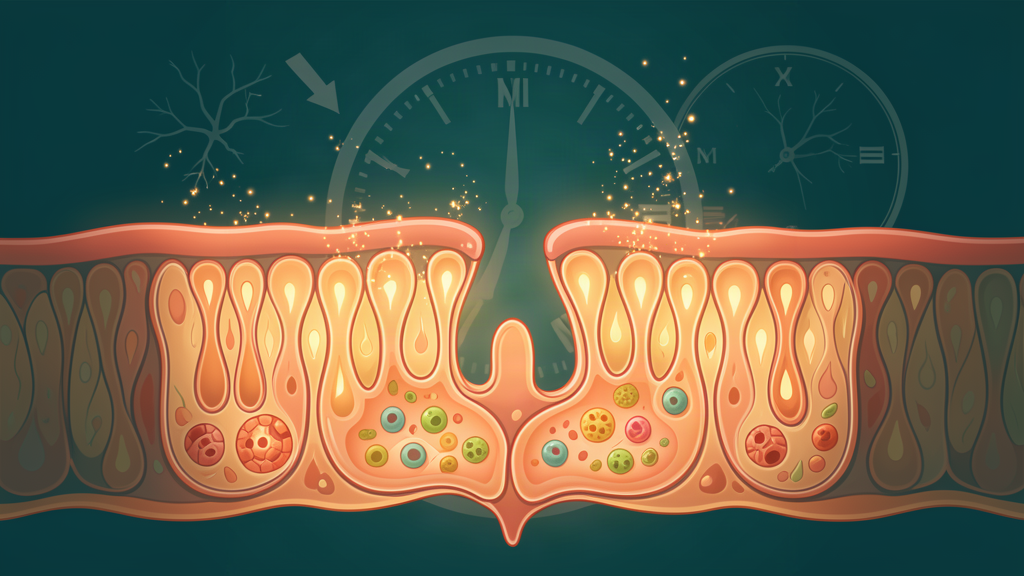
To grasp why this study matters, you need one piece of anatomy. Your intestinal lining is one of the most aggressive remodeling projects in your body. The entire surface is completely replaced every 5 to 10 days, driven by intestinal stem cells tucked into the crypts of the gut wall. That speed is essential — the lining takes a beating from digestive enzymes, food particles, and microbes — but it is also why the gut is one of the most common sites for cancers to originate. Fast division means more chances for replication errors.
Yilmaz and his colleagues had already shown years earlier, in a landmark Cell Stem Cell paper, what fasting does to these cells. After just 24 hours without food, mouse intestinal stem cells switched their metabolism: they stopped burning carbohydrates and started burning fat. That metabolic switch did not just keep the cells alive — it enhanced their regenerative function, and the effect held even in aged mice, whose stem cells had been losing their edge. Fasting, in other words, restores regenerative capacity to aging gut tissue.
This is also where the fasting benefits most people know about come in. During the fasted state, cells shift into repair mode, clearing damaged components through autophagy — the cellular housekeeping process that fasting is famous for. If you want the full timeline of when that process ramps up in humans, see our breakdown of when autophagy actually starts.
So the complete picture looks like this: fasting suppresses gut stem cell activity while pushing cells into cleanup mode, then refeeding triggers a regeneration surge that rebuilds the lining — a surge strong enough to outpace even never-fasted tissue. In a healthy gut, that is repair. In a gut carrying a mutation, that same surge can expand the damaged clone. The mechanism is genuinely double-edged.
Why the Refeeding Window Is the Part That Matters
The most common misreading of the MIT study is treating it as a verdict on fasting itself. Read the design again: the tumors did not form during the fast. They formed during the refeeding burst, and only when a mutation was present. The fast set the stage; the meal after the fast performed the play.
Think of it like a construction crew. A 24-hour fast sends the crew home to clean and restock. Refeeding calls them back at double speed to rebuild. If the blueprints are sound, you get a fresh, healthy gut lining in record time. If a section of the blueprints is corrupted, working at double speed means the corrupted section gets built bigger, faster. Speed itself is not the enemy — unverified material at speed is.
Two honest caveats keep this in proportion. First, these were mice carrying an experimentally introduced mutation; they are a deliberate worst-case model, not a simulation of an average healthy adult. Second, nobody has demonstrated this refeeding-and-tumor mechanism in humans. What the human data actually show runs the other direction in several trials: Valter Longo and colleagues combined a fasting-mimicking diet with standard chemotherapy in breast and ovarian cancer patients, reporting improved treatment tolerance in a randomized pilot and, in a later subanalysis of a phase Ib trial, better overall survival in advanced triple-negative breast cancer patients. Human evidence on fasting and cancer is still early, but it is not pointing at refeeding meals as a driver of cancer in healthy people. For more of that background, our full guide to fasting and cancer prevention covers the wider evidence base.
That said, the study does hand fasters one genuinely useful lesson: what you eat in the hours after a fast deserves at least as much attention as the fast itself. Most fasting content obsesses over the eating window and treats breaking the fast as an afterthought. The MIT data argue the opposite priority.
What This Means for Your Fasting Practice
None of this is a reason to quit fasting. It is a reason to break your fast like an adult. Four practical takeaways come straight out of the research.
1. Treat the first meal after a prolonged fast as a decision, not a snack. After a 24-hour or longer fast, your gut stem cells are entering their surge. Fueling that surge with ultra-processed food — fried anything, refined sugar, processed meat — is the one thing the study would predict you should not do. Build the refeed around fiber, vegetables, and intact proteins instead. Our complete refeeding guide walks through exact meal sequences for every fast length.
2. Load up on polyphenols and cruciferous vegetables. Compounds like sulforaphane from broccoli and its seeds, found in sulforaphane supplement, are among the most studied dietary molecules for supporting the body natural detoxification pathways and healthy cell turnover. Extra virgin olive oil, particularly high-polyphenol extra virgin olive oil, brings hydroxytyrosol and oleocanthal, polyphenols with their own research trail for supporting gut health. A daily cup of organic matcha powder adds EGCG, another polyphenol with published research on cellular protection. These are not cancer shields, and nobody should market them as such — they are simply the foods that best support a clean, well-regulated rebuild.
3. Keep fasting sessions reasonable, and keep refeeds high-quality. Nothing in this research argues against time-restricted eating or regular 16:8 schedules. The concerns concentrate around repeated prolonged fasts followed by poor-quality refeeds. Rotate extended fasts with careful refeed days, and let the refeed day do real nutritional work. For the mechanisms behind why the fasted state matters at all, our cancer prevention guide goes deeper — and if you want the science mapped to daily practice, The Cancer Code by Dr. Jason Fung remains the clearest book-length treatment of how fasting interacts with cancer biology from an actual fasting clinician.
4. If you have a known history of GI polyps or inflammatory bowel disease, talk to your doctor before attempting extended fasts. This is exactly the population in which the mutation-plus-proliferation mechanism would matter most, and it is the group for whom the mouse findings deserve real caution rather than hand-waving. Everyone else can file the study under interesting mechanism, not alarm.
One more resource worth having on the shelf: The Longevity Diet by Valter Longo from Valter Longo, whose fasting-mimicking research produced the human chemotherapy trials cited above. It explains why his protocol keeps small, carefully composed meals in the mix during fasting-mimicking periods — a design choice that keeps regeneration supported without a full refeeding surge.
Frequently Asked Questions
Does this study mean fasting causes cancer?
No. That is the headline version, not the finding. Tumors developed only in mice that already carried an experimentally introduced cancer-initiating mutation, and only during the refeeding surge. Fasting itself did not create mutations, and no human study has linked fasting to increased intestinal cancer risk. If anything, the human fasting-mimicking and chemotherapy trials have pointed in the protective direction.
How long should I fast for gut regeneration benefits?
In the mouse research, the regeneration effects showed up around the 24-hour mark, where the metabolic switch from carbs to fat kicks in. Mouse metabolism does not map one-to-one onto humans, but 16 to 24 hours is a reasonable window where most fasters report the strongest subjective effects, and where autophagy is well underway in human extrapolations. The regenerative surge then lands in the first meals after the fast.
What should I eat to break a fast safely?
Break the fast with whole foods: cooked vegetables, bone broth, quality protein, healthy fats, and fiber. Avoid the classic post-fast impulse meals — pastries, fried food, giant refined-carb plates. The goal is a steady refeed that supports the regeneration surge with good raw materials. Complete meal sequences for every fast length are in our refeeding guide linked above.
Is the fasting mimicking diet a safer alternative?
The fasting-mimicking diet keeps small, precise meals in the schedule rather than going fully fasted, and it is the approach behind Longo human chemotherapy research. It still produces fasting-like metabolic markers — ketones, reduced IGF-1 — while avoiding a total fast. Whether that trade produces better or worse outcomes for gut stem cells specifically has not been directly compared in a trial, so treat it as a different tool, not a proven safer one. Our site covered the fasting-mimicking trend in depth earlier this year.
Should people with a family history of colon cancer avoid fasting?
A family history alone is not a contraindication, but it is a reason to get screening current and to keep extended fasts moderate and refeeds high-quality. The mechanism in the MIT study requires an existing mutation, and inherited syndromes raise the odds that one is present. Bring the study to your gastroenterologist — it is a legitimate conversation to have, and it is the kind of nuance that gets lost in headlines.
The Bottom Line
The MIT study is not an anti-fasting study. It is a refeeding study. Fasting suppresses gut stem cells during the fast and triggers a powerful regeneration surge afterward — a surge that is genuinely beneficial in a healthy gut and only problematic in the presence of an existing mutation. The actionable takeaway is simple and, honestly, overdue in fasting circles: stop treating the meal that breaks your fast as an afterthought. Build it from whole foods, load it with polyphenols and fiber, and give the rebuilding gut the materials it actually needs.
Fasting remains one of the most powerful tools in the health toolkit, and the science keeps getting more precise about how to use it. Check the books and supplements recommended above on Amazon, pair them with the refeeding and cancer-prevention guides linked in this article, and keep your refeeds as considered as your fasts.
As an Amazon Associate, I earn from qualifying purchases.