
Introduction: The 72-Hour Threshold
Most people who practice intermittent fasting never push beyond a 24-hour window. But what happens when you go further? A landmark study published in May 2026 by researchers analyzing seven-day fasting protocols revealed something remarkable: the human body doesn’t just survive without food — it fundamentally reorganizes itself at the cellular level.
The research, published in ScienceDaily, found that major metabolic shifts don’t appear until approximately three days into a water-only fast. Before that point, your body is essentially burning through glycogen reserves and transitioning to fat oxidation. After day three, a cascade of processes kicks in — including enhanced autophagy, stem cell activation, and immune system recycling — that simply don’t happen during shorter fasts.
In this deep dive, we’ll break down exactly what happens at each stage of an extended fast, what the latest science says about the metabolic timeline, and whether pushing past 72 hours is worth the effort for your specific goals.
The Metabolic Timeline: What Happens Hour by Hour
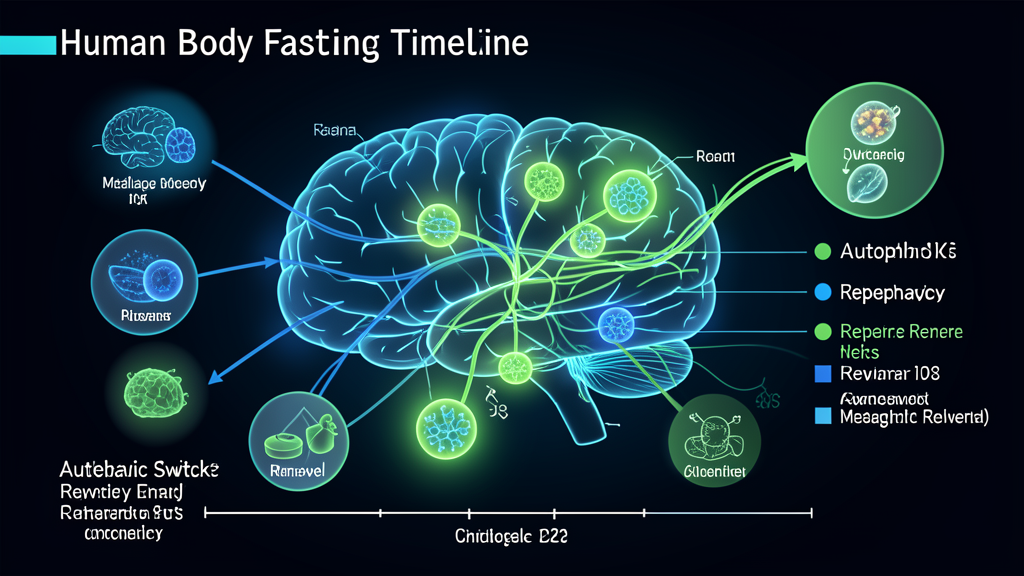
Understanding fasting requires understanding the metabolic switches your body flips at predictable intervals. Here’s the science-backed timeline:
Hours 0–12: The Fed State to Post-Absorptive Transition
After your last meal, your body spends roughly 4–6 hours digesting and absorbing nutrients. Blood glucose rises, insulin spikes, and excess energy gets stored as glycogen in the liver and muscles. By hour 12, you’ve entered the post-absorptive state — your body has finished processing food and is now drawing on stored energy. Blood sugar stabilizes, and insulin levels begin to fall.
For most intermittent fasters doing 16/8 or 18/6 protocols, this is where the magic begins. Lower insulin levels trigger the body to start mobilizing fatty acids from adipose tissue, and growth hormone begins to rise — a critical hormone for preserving lean muscle mass during fasting.
Hours 12–24: Glycogen Depletion and Fat Adaptation
Your liver stores approximately 80–100 grams of glycogen — enough to fuel your brain and body for about 24 hours. During this phase, your body gradually shifts from burning glucose to burning fat. Research from Johns Hopkins Medicine confirms that this metabolic switch is one of the primary mechanisms behind intermittent fasting’s benefits for weight loss and insulin sensitivity.
By the 24-hour mark, most of your liver glycogen is depleted. You may experience increased hunger, mild irritability, and difficulty concentrating — symptoms that typically peak and then subside as your body becomes more efficient at using ketones for fuel.
Hours 24–48: Deep Ketosis and Fat Oxidation
Once glycogen is largely exhausted, your body enters deep ketosis. Liver-derived ketone bodies (beta-hydroxybutyrate, acetoacetate, and acetone) become your brain’s primary fuel source. This is the phase where many extended fasters report increased mental clarity, reduced inflammation, and a paradoxical decrease in hunger.
A 2026 Cochrane review comparing intermittent fasting to continuous calorie restriction found that insulin sensitivity improvements were most pronounced in fasting protocols that extended beyond 24 hours. The researchers noted that prolonged fasting produces metabolic adaptations that calorie restriction alone does not replicate — particularly in how the body partitions energy between tissues.
Hours 48–72: The Autophagy Acceleration Zone
This is where the science gets truly fascinating. Autophagy — your body’s cellular “cleanup crew” — ramps up significantly between 48 and 72 hours. During autophagy, cells break down damaged proteins, dysfunctional mitochondria, and misfolded proteins, then recycle the components for new, healthy cellular machinery.
Dr. Yoshinori Ohsumi, who won the 2016 Nobel Prize for discovering the mechanisms of autophagy, has noted that fasting is one of the most potent natural stimulators of this process. The May 2026 research confirmed that autophagy markers increase exponentially after the 72-hour threshold — not linearly, but with a dramatic surge that correlates with the body’s shift to survival-mode cellular maintenance.
This is the phase that makes extended fasting qualitatively different from intermittent fasting. A 16/8 protocol provides some autophagy benefits, but a 72-hour fast unlocks a level of cellular housekeeping that shorter fasts simply cannot achieve.
Days 3–5: Stem Cell Activation and Immune Reset
Perhaps the most groundbreaking finding from recent fasting research involves what happens after day three. Studies on prolonged fasting have shown that the body begins to recycle damaged immune cells and activate stem cell-based regeneration.
Research conducted at the University of Southern California found that fasting for 48–72 hours triggers the breakdown of old, damaged white blood cells. When refeeding occurs, the body generates entirely new immune cells from stem cell reserves. This process — essentially an immune system “reboot” — has implications for everything from autoimmune conditions to recovery from chemotherapy.
During days 3–5 of a water-only fast:
- Growth hormone levels surge — up to 5x normal levels, protecting muscle mass and promoting fat utilization
- Inflammatory markers drop significantly — C-reactive protein and IL-6 decrease, reducing systemic inflammation
- Brain-derived neurotrophic factor (BDNF) increases — supporting neuroplasticity, learning, and mood regulation
- Blood glucose stabilizes at lower levels — the body becomes more efficient at glucose sparing, using ketones for most energy needs
- Insulin sensitivity reaches peak levels — making the refeeding phase a critical window for metabolic health
It’s important to note that these benefits come with significant physiological stress. Days 3–5 are when most people experience the strongest symptoms: fatigue, dizziness, cold sensitivity, and intense food cravings. Electrolyte balance becomes critical during this phase — many experienced fasters supplement with electrolyte packets like LMNT to manage symptoms without breaking the fast.
Day 7 and Beyond: The Extended Fasting Frontier
Pushing past a seven-day fast enters territory that most researchers consider should only be undertaken with medical supervision. However, the physiological data from controlled studies is remarkable:
Metabolic rate doesn’t drop significantly until day 3–4 of a fast, then decreases by approximately 20% — far less than the metabolic slowdown seen with chronic calorie restriction. This suggests that the body “prefers” fasting over chronic undereating, which makes evolutionary sense: feast-famine cycles were the norm for most of human history.
Ketone production peaks around days 5–7, reaching concentrations 3–5x higher than during standard intermittent fasting. These elevated ketones serve as both fuel and signaling molecules, activating pathways that promote longevity and reduce oxidative stress.
Protein conservation becomes highly efficient after day 3. The body dramatically reduces muscle protein breakdown, instead relying almost exclusively on fat stores. This is mediated by the surge in growth hormone and the shift in the glucagon-to-insulin ratio.
For those considering extended fasting, proper preparation is essential. Having reliable tools to monitor your body’s response can mean the difference between a productive fast and a dangerous one. A continuous glucose monitor provides real-time insight into how your blood sugar responds to prolonged fasting, while a ketone meter helps you track whether you’ve reached the deep ketosis that drives autophagy.
The Science of Refeeding: Why Breaking a Fast Matters as Much as Starting One
One of the most underappreciated aspects of extended fasting is the refeeding phase. After 72+ hours without food, your digestive system has essentially gone dormant — enzyme production decreases, gut motility slows, and the intestinal lining thins. Breaking a fast incorrectly can cause serious gastrointestinal distress, electrolyte imbalances, and in extreme cases, refeeding syndrome.
The research consensus is clear: break extended fasts gradually with small, easily digestible meals. Bone broth is widely recommended as a first food — it provides electrolytes, amino acids (particularly glutamine, which supports gut lining repair), and hydration without overwhelming the digestive system. A high-quality bone broth is an essential tool for anyone practicing extended fasting.
Follow bone broth with small portions of cooked vegetables, avocado, or fermented foods like sauerkraut. Avoid large meals, refined carbohydrates, and alcohol for at least 24 hours after breaking an extended fast.
Practical Takeaways: Which Fast Duration Is Right for You?
The science doesn’t support a one-size-fits-all approach to fasting duration. Here’s a framework for choosing:
16:8 or 18:6 intermittent fasting — Ideal for daily metabolic health, weight management, and insulin sensitivity. Sustainable long-term, minimal risk, well-studied. Best for: most people, especially those new to fasting.
24–48 hour fasts — Provides deeper ketosis and more pronounced autophagy than daily IF. Can be done 1–2x per week. Best for: experienced fasters looking to accelerate fat loss or improve metabolic markers.
72-hour (3-day) fasts — The threshold for significant autophagy activation, immune system recycling, and stem cell regeneration. Should be done monthly at most, with proper preparation. Best for: those with specific health goals (autoimmune support, metabolic reset, longevity optimization).
5–7 day fasts — Maximum autophagy, deep immune reset, and profound metabolic adaptation. Medical supervision strongly recommended. Not appropriate for pregnant women, underweight individuals, those with eating disorder history, or people on insulin or blood sugar-lowering medications. Best for: supervised therapeutic fasting under medical guidance.
Conclusion
The latest research confirms what ancient fasting traditions have long intuited: extended fasting produces biological changes that shorter fasts cannot replicate. The 72-hour threshold represents a genuine inflection point where autophagy, immune regeneration, and metabolic reprogramming shift from incremental to exponential.
However, more isn’t always better. The benefits of fasting follow a curve — significant gains at 16–24 hours, accelerating returns up to 72 hours, and diminishing (or potentially harmful) returns beyond 7 days for most people. The key is matching your fasting protocol to your specific goals, health status, and experience level.
Whether you’re just starting with a 16:8 protocol or considering your first 72-hour fast, the most important factors are preparation, electrolyte management, and a thoughtful refeeding strategy. Your body is remarkably capable of adapting to fasting — your job is to support it with the right tools and knowledge.
Frequently Asked Questions
How long do you need to fast to activate autophagy?
While some autophagy occurs during shorter fasts, research suggests the most significant activation begins around 48–72 hours. During a standard 16:8 intermittent fast, you’ll get mild autophagy benefits, but the exponential increase doesn’t occur until you cross the 72-hour threshold. For most people, combining regular 18–24 hour fasts with occasional 48–72 hour fasts provides the best balance of autophagy benefits and practicality.
Is it safe to exercise during an extended fast?
Light to moderate exercise (walking, yoga, light resistance training) is generally safe during the first 48 hours of a fast. Beyond 72 hours, intense exercise is not recommended — your body is prioritizing cellular repair over physical performance, and pushing too hard can increase cortisol and impair the recovery processes you’re trying to activate. Listen to your body and scale back intensity as the fast progresses.
What should I take while fasting to support my body?
Electrolytes are non-negotiable during any fast longer than 24 hours. Sodium, potassium, and magnesium prevent the headaches, fatigue, and cramps that cause most people to abandon their fasts prematurely. A quality electrolyte mix without sugar or calories is essential. Black coffee and plain tea are acceptable and may actually enhance autophagy through caffeine’s effects on AMPK pathways.
Will I lose muscle during an extended fast?
The research is reassuring: muscle loss during fasting is significantly less than most people fear. Growth hormone increases dramatically during fasting (up to 5x normal levels by day 3), which directly protects muscle tissue. Studies show that the majority of weight lost during a 7-day fast comes from fat stores, not muscle. However, prolonged fasting without adequate protein during refeeding can lead to muscle loss — which is why the refeeding phase is so critical.
Can I do extended fasting if I’m on medication?
This depends entirely on the medication. Metformin and other diabetes medications may need dosage adjustment during fasting to prevent hypoglycemia. Blood pressure medications may need reduction as fasting naturally lowers blood pressure. Insulin is particularly risky during extended fasts without medical supervision. Always consult your healthcare provider before attempting any fast longer than 24 hours if you take prescription medications.
As an Amazon Associate, I earn from qualifying purchases.