
NAD+, Sirtuins, and Fasting: The Longevity Pathways
Every time you skip a meal, something remarkable happens inside your cells. Your body doesn’t just burn stored fat — it activates ancient molecular pathways that can slow aging, repair DNA, and protect your brain. The star players? Two molecules called NAD+ and sirtuins, working together with the cellular energy sensors AMPK and mTOR to orchestrate one of the most powerful longevity responses known to science.
In 2026, researchers are finally connecting the dots between fasting, these cellular pathways, and real-world health outcomes. This deep dive explains exactly how fasting flips the switch on your body’s longevity machinery — and what you can do to maximize the effect.
What Is NAD+ and Why Does It Matter?
NAD+ (nicotinamide adenine dinucleotide) is a coenzyme found in every living cell. It plays a critical role in two fundamental processes: energy metabolism and DNA repair. Without adequate NAD+, your mitochondria — the power plants of your cells — cannot efficiently convert food into ATP, the energy currency that keeps you alive. Every heartbeat, every thought, every breath depends on NAD+ being present in sufficient quantities.
The problem is that NAD+ levels decline sharply with age. By the time you reach 50, your NAD+ pool may be half of what it was in your twenties. This decline is linked to increased oxidative stress, impaired mitochondrial function, and the accumulation of cellular damage that drives aging. Studies published in Frontiers in Aging Neuroscience (January 2026) confirmed that aging brains show altered NAD+/NADH ratios, and that interventions restoring this balance — including fasting — can reverse age-related cognitive decline.
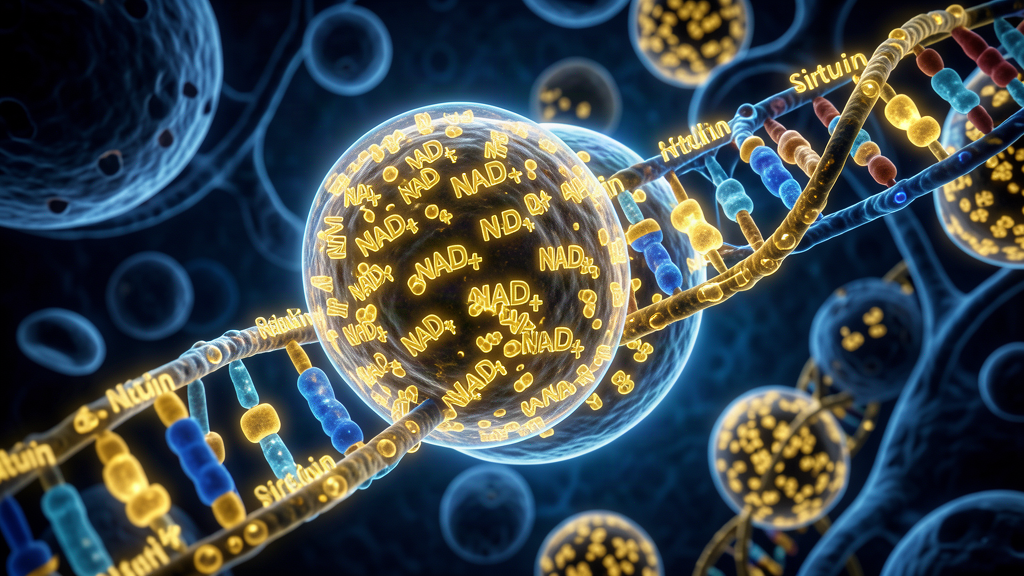
NAD+ doesn’t just sit there passively. It serves as fuel for sirtuins, the family of proteins that act as your cells’ master regulators of longevity. When NAD+ levels are high, sirtuins are active and your cells enter repair mode. When NAD+ drops, sirtuins go dormant, and cellular maintenance stalls. This is why many researchers consider NAD+ decline one of the fundamental drivers of aging — not just a symptom of it.
Think of NAD+ as the currency your cells use to pay for repairs. When the supply is充足 (plentiful), repairs happen efficiently and damage is cleared. When it runs low, damage accumulates, mitochondria become less efficient, and the hallmarks of aging — wrinkles, fatigue, cognitive decline — become visible. Fasting is one of the most reliable ways to replenish this cellular currency without spending a dime on supplements.
Sirtuins: Your Cells’ Built-In Longevity Switch
Sirtuins are a family of seven proteins (SIRT1 through SIRT7) that function as NAD+-dependent deacetylases. In plain language, they remove chemical tags (acetyl groups) from other proteins, activating or silencing genes that control aging, inflammation, and cellular repair. The name “sirtuin” comes from the yeast Sir2 gene, which was first discovered to extend lifespan in simple organisms.
Here’s what makes sirtuins remarkable — and why they matter for anyone practicing intermittent fasting:
- SIRT1 — The most studied sirtuin and the primary bridge between fasting and longevity. Activated by fasting and calorie restriction, SIRT1 promotes autophagy (your cells’ self-cleaning system), reduces inflammation, and improves insulin sensitivity. A 2026 narrative review in the Journal of Gerontology confirmed that SIRT1 activation through NAD+ boosting is one of the most promising anti-aging interventions currently under investigation. When you fast and NAD+ rises, SIRT1 goes to work deacetylating proteins that control inflammation, fat metabolism, and even circadian rhythm.
- SIRT3 — Works primarily inside mitochondria, protecting them from oxidative damage and maintaining energy production efficiency. SIRT3 activation during fasting helps explain why intermittent fasting improves mitochondrial function even in older adults. Studies show that SIRT3 knockout mice age prematurely, with accelerated cardiac and neuronal degeneration — underscoring how critical this single sirtuin is for healthy aging.
- SIRT6 — The “genomic guardian.” SIRT6 repairs DNA double-strand breaks, maintains telomere length, and suppresses inflammation at the genetic level. Mice engineered to overexpress SIRT6 live significantly longer. For fasters, SIRT6 activation means better DNA repair and reduced cancer risk — benefits that compound over years of consistent fasting practice.
The critical insight is that sirtuins require NAD+ to function. They don’t work in a vacuum. This is why declining NAD+ with age is so damaging — it effectively shuts down your sirtuin-powered longevity defense system. Fasting solves this problem by naturally boosting NAD+ levels while simultaneously activating the pathways that sirtuins control. It’s a two-for-one deal that no pill can fully replicate.
The Fasting-NAD+ Connection: How Skipping Meals Activates Longevity
When you stop eating for 16 hours or more, your body undergoes a metabolic shift that directly impacts NAD+ and sirtuin activity. Here’s the chain reaction, broken down into three distinct phases:
Phase 1 (0–12 hours): Glucose depletion. Your body burns through its last meal and begins tapping into glycogen stores. Blood glucose and insulin levels drop. AMPK — the cellular energy sensor that acts as a fuel gauge — starts waking up as ATP levels decrease. During this phase, you may feel mild hunger as ghrelin (the hunger hormone) peaks, but your body is already beginning the transition from fed to fasted metabolism.
Phase 2 (12–18 hours): AMPK activation and mTOR suppression. This is where the magic begins. As AMPK activates, it sends a clear “energy deficit” signal through your cells. Simultaneously, mTOR (the growth and building pathway) gets suppressed. mTOR promotes cell growth and proliferation, but when it’s chronically active — as it is in people who eat frequently — it suppresses autophagy and accelerates aging. Fasting flips the mTOR switch off, removing the brake on cellular repair. AMPK also activates ULK1, the protein that initiates autophagy, setting the stage for the cleanup that follows.
Phase 3 (18–24+ hours): NAD+ surge and sirtuin activation. With AMPK active and mTOR suppressed, your cells shift into conservation and repair mode. NAD+ levels rise because the body upregulates NAMPT, the rate-limiting enzyme in NAD+ biosynthesis. This NAD+ surge powers up SIRT1 and SIRT3, which in turn activate autophagy, enhance mitochondrial function, and begin clearing damaged proteins and organelles. The result is a cascade of cellular renewal that researchers have linked to improved metabolic health, better cognitive function, and reduced cancer risk.
Research from Cells (September 2025) mapped these interactions in detail, showing that NAD+ metabolism, autophagy, and nutrient-sensing pathways (mTOR, AMPK, sirtuins) form an integrated network. Fasting doesn’t just activate one pathway — it triggers a coordinated cellular response where each pathway amplifies the others. It’s like flipping a single master switch that activates an entire home renovation crew.
This is why 16:8 intermittent fasting hits the sweet spot: it provides enough fasting time to activate AMPK and begin the NAD+ response, without the risks associated with extended multi-day fasts for most people. The 16-hour mark is where most of the longevity magic happens, and the 18-hour mark is where NAD+ levels begin their most significant rise.
Practical Implications: What This Means for Your Fasting Practice
Understanding these pathways isn’t just academic — it directly affects how you should approach fasting for longevity. Here are five evidence-based strategies to maximize the NAD+/sirtuin response:
1. Timing matters more than duration. The 16-18 hour window is when AMPK fully activates and NAD+ begins to rise. Rushing to break your fast at 14 hours may cut the longevity benefits short. For most people practicing 16:8, extending to a 17-18 hour fast on some days can amplify the NAD+ response without extreme discomfort. You don’t need to do this every day — even 3-4 times per week produces meaningful benefits.
2. Fasted exercise amplifies the effect. Exercise independently activates AMPK and boosts NAD+. Combining a morning workout with a 16+ hour fast creates a “double hit” that maximizes both pathways. A 2026 study in PMC showed that high-intensity exercise enhances the SIRT1/MFN2 pathway, improving mitochondrial function through NAD+-mediated mechanisms. Even a 20-30 minute brisk walk during your fasting window can enhance the response.
3. NAD+ precursor supplements can support the fast. NMN (nicotinamide mononucleotide) and NR (nicotinamide riboside) are the two most studied NAD+ precursors. A January 2026 human trial directly compared the three main precursors and found that oral supplementation with NR or NMN sustainably doubles circulating NAD+, while plain nicotinamide (Nam) does not. Combining NMN supplementation with time-restricted eating may produce additive benefits, though researchers note that direct evidence for this combination in humans is still limited.
Here are three well-regarded NAD+ supplements worth considering:
- NMN supplements (1000mg dose) — The most bioavailable NAD+ precursor, directly converted to NAD+ in cells
- NR (Nicotinamide Riboside) supplements — Studied in over 200 clinical trials, well-tolerated safety profile
- Resveratrol + NMN combo supplements — Resveratrol is a known SIRT1 activator that may amplify NAD+ benefits
4. Quality sleep preserves NAD+. Sleep deprivation depletes NAD+ through increased PARP activity — a DNA repair enzyme that consumes NAD+ to fix damage from oxidative stress. One night of poor sleep can measurably reduce your NAD+ levels, undermining the benefits of fasting. Prioritizing 7-9 hours of quality sleep protects the NAD+ pool you’ve built through fasting. Consider magnesium glycinate, which supports both sleep quality and mitochondrial function.
5. What you eat during your eating window matters. While fasting is the primary trigger, your diet during eating hours affects how well these pathways respond. A diet rich in polyphenols (found in berries, green tea, and dark chocolate) and adequate protein supports sirtuin activity and NAD+ synthesis. Blueberries, in particular, contain compounds that activate SIRT1 directly. The goal isn’t just fasting — it’s strategic nutrient timing that maximizes the fasting response.
FAQ
How long do I need to fast to activate NAD+ and sirtuin pathways?
Most research suggests AMPK activation begins around 12-14 hours of fasting, with NAD+ levels rising significantly after 16-18 hours. For the full longevity response (AMPK activation + mTOR suppression + NAD+ surge), aim for at least 16 hours of fasting. This is why 16:8 intermittent fasting has become the standard protocol for longevity-focused practitioners. Extended fasts (24-72 hours) produce stronger responses but carry more risk and should be done with medical supervision.
Do NMN and NR supplements actually work during fasting?
A January 2026 human trial found that oral NR or NMN supplementation sustains circulating NAD+ levels at roughly double baseline. While combining these supplements with fasting may produce additive benefits, direct clinical evidence for the combination is still limited. The supplements work best as a complement to — not a replacement for — fasting. They provide additional NAD+ precursors that support sirtuin activity during the fasting window.
Can I take NMN or NR while fasting without breaking my fast?
Plain NMN and NR capsules contain minimal calories (typically under 5 calories per serving) and are unlikely to trigger an insulin response or break a fast. However, some formulations include fillers or sweeteners that could affect fasting. Choose pure, unflavored NMN or NR supplements with no additives to be safe. Take them with water during your fasting window for maximum absorption.
What happens to AMPK and mTOR during a 16:8 fast?
During a 16:8 fast, AMPK gradually activates as glucose and insulin levels fall (typically starting around hour 12-14). mTOR — the growth pathway — is simultaneously suppressed. This creates the optimal environment for autophagy: your cells stop building new components and start recycling damaged ones. The 16:8 protocol provides enough time for this switch to fully engage while remaining practical for most lifestyles.
Is there a difference between NMN and NR for NAD+ boosting?
Both are effective NAD+ precursors that work through different metabolic pathways. NR is converted to NMN in the body before becoming NAD+, while supplemental NMN may bypass this step. The January 2026 head-to-head trial found both NR and NMN effectively doubled circulating NAD+. NMN is generally considered more bioavailable (your body absorbs a higher percentage), but NR has a longer track record of human clinical trials. Either is a solid choice for supporting NAD+ levels during fasting.
As an Amazon Associate, I earn from qualifying purchases.
Related posts:
 Exploring The Connection Between Extended Fasting And Longevity
 The Science Behind Fasting And Longevity
 Most Popular Intermittent Fasting Techniques For Longevity And Anti-aging Benefits
 Does Fasting Work Without Eating Less? What 2026 Studies Say
 Spermidine: The Missing Link in Fasting Autophagy 2026