
Walking Pads and Fasting: The Cozy Cardio Trend 2026
Searches for under-desk treadmills are up roughly 400% year over year, TikTok’s “walking pad treadmill 2026” discover page has already pulled in millions of views, and “cozy cardio” — candles lit, fuzzy socks on, a gentle walk in your living room while a show plays — has become one of the most-watched fitness trends of the year. Meanwhile, the fasting community has been doing a version of the same thing for years: moving slowly, insulin low, letting the body run on fat instead of the last meal.
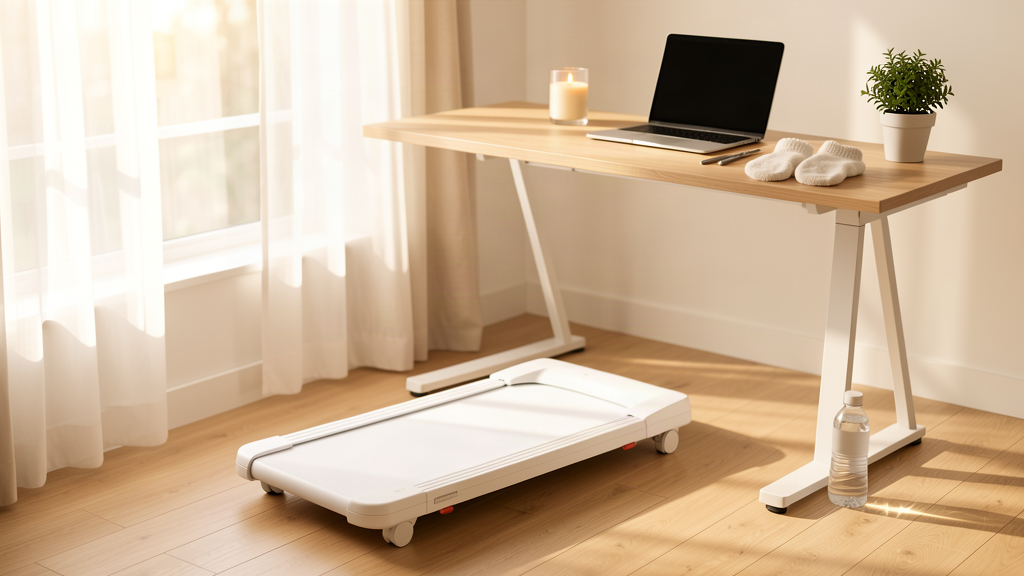
Put the two together and you get the lowest-friction health stack of 2026. A walking pad rolls out for ten minutes inside your eating window or your fasting window, and requires zero commute, zero gym membership, and zero intensity. Here is what is driving the walking pad boom, why fasted walking pairs so naturally with intermittent fasting, how to time your sessions around a 16:8 day, the mistakes that kill the habit, and the gear worth buying.
What’s Trending: Why Walking Pads Took Over 2026
The walking pad went from a niche home-office hack to the fitness accessory of the year in about eighteen months. Retail trackers put search interest for under-desk treadmills at roughly 400% growth compared with last year, and TikTok’s hashtag ecosystem around walking pads, incline walking, and under-desk treadmills has turned quiet treadmill walks into one of the most-watched categories on the platform. The “walking pad treadmill 2026” discover feed alone carries millions of views, with creators posting daily step counts from desks, kitchens, and living rooms.
The companion trend is cozy cardio, popularized by creator Hope Zuckerbrow and covered everywhere from TODAY to AARP. The premise is almost aggressively low-stakes: you walk slowly at home, in comfortable clothes, with ambient lighting and something pleasant playing in the background, and you do it consistently rather than intensely. No heart-rate-zone pressure, no 5 a.m. alarms, no locker room. Mainstream outlets picked it up because it solves the oldest problem in fitness — people stop doing things that feel like punishment.
Three forces made 2026 the year it went mainstream:
- Hybrid work normalized movement at the desk. Standing desks became standard, and a walking pad is the natural upgrade from standing still. Walking at 1.5–2.5 mph is slow enough to type, take calls, and read email.
- The market finally split into real tiers. Reviewers note a clear divide between cheap pads that advertise inflated motor ratings and fail under sustained use, and premium machines that want a monthly subscription on top of a high sticker price. The middle tier — foldable, quiet, remote-controlled pads in the low hundreds — is where most people land, and it is good enough now.
- Gym fatigue is real. After years of content about optimal training, a large audience just wants something they will actually repeat. A pad that lives under the couch and comes out for ten minutes wins on adherence, which is the only metric that matters over a year.
For fasters, that last point is the whole argument: the best movement habit is the one that does not require changing clothes.
Why Walking and Fasting Belong Together
Walking is the rare exercise that fits inside a fasted state without fighting it. The reason comes down to intensity and fuel.
Low-intensity movement runs on fat, not glucose. During a fast, insulin is low and liver glycogen is drawn down, which shifts fuel selection toward fat oxidation. Walking at a conversational pace sits well inside that window — your body can supply the energy from stored fat without demanding a carbohydrate refill. This is the practical definition of metabolic flexibility: the ability to switch between fuel sources cleanly, and something CGM wearers watch play out on a glucose graph in real time. A easy walk barely moves the line. A hard interval session will.
Walking does not break a fast for most people. A gentle stroll does not meaningfully spike blood glucose or stress hormones the way prolonged intense training can. This is why most fasting guidance treats light movement as neutral-to-positive, while flagging all-out sessions as the thing to schedule carefully. For a standard 16:8 schedule, a 20–30 minute easy walk during the back half of the fast is comfortably inside the “keep doing it” territory. There is a fuller discussion of where the line sits in our breakdown of exercising while fasting.
Fasted movement may amplify the cellular cleanup signal. Research on combining fasting with exercise has found that the two together can potentiate autophagy activation in human skeletal muscle — the cellular recycling process that is one of the headline reasons people fast in the first place. The study work used cycling, but the principle carries over to any low-grade movement done in the fasted state. You do not need to sprint to get the effect; you need to be moving while the fast is doing its work.
Walking is the biggest lever in daily energy expenditure that nobody counts. Exercise calories are a small slice of a typical day. Non-exercise activity — the walking, standing, fidgeting, and carrying you do outside the gym — is where most daily movement calories come from, and it is the variable that quietly decides whether a fasting protocol produces visible change. A fasted day spent entirely in a chair and a fasted day spent accumulating 8,000–10,000 steps on a walking pad are not the same day, even if the eating window is identical.
The honest caveat: fasted walking increases fat oxidation during the walk, but total fat loss still depends on overall energy balance and adherence. Walking is not a cheat code that cancels out a surplus. What it does is make the fasted window more metabolically active and give you a habit that survives contact with a busy week.
The other half of the story is what happens when you do eat.
Use the 10-Minute Post-Meal Walk to Protect Your Progress
The most useful research on walking right now is not about fasted walking at all — it is about what you do after you break your fast.
A 2025 study in Scientific Reports found that a 10-minute walk immediately after a glucose load had a positive impact on postprandial blood glucose. An earlier trial found a 10-minute walk about 30 minutes after dinner was as effective as a 30-minute walk at the same time point for post-meal glucose control. More recent 2026 coverage of movement-break research puts the effect size for short walks after meals in the range of roughly 12–22% lower glucose response compared with sitting.
Read that through a fasting lens and it becomes a very practical rule: the first 10–20 minutes after you break your fast is the highest-value walking window of the day. You have just gone 16 hours with improved insulin sensitivity. Sitting straight down with a big first meal hands a large glucose load to a system that was primed to handle it — and then blunts the advantage. A short walk after the meal keeps the response smooth.
This is exactly what a walking pad is built for. Ten minutes, no shoes, no weather, no change of clothes, straight from the table to the pad. It also maps neatly onto the hunger-craving cycle: cravings tend to spike and then pass within 20–30 minutes, and a low-effort activity during that window is one of the more reliable ways to ride them out without opening the pantry early.
How to Time Your Walking Pad Sessions on a 16:8 Day
You do not need a complex protocol. Here is a schedule that works for a typical 16:8 faster with an eating window from noon to 8 p.m.
Morning, hours 12–14 of the fast: 20–30 minutes
This is the classic fasted walk. Insulin is low, glycogen is drawn down, and you are deep enough into the fast that fat oxidation is the dominant fuel. Keep the pace conversational — if you can hold a sentence, you are in the right zone. Under a desk while answering email is a perfect version of this.
Mid-afternoon, when cravings hit: 10 minutes
Hunger is episodic, not constant. When a wave arrives, roll the pad out and walk through it. The activity occupies your hands and attention, and the craving typically crests and fades inside half an hour. This is the fasted equivalent of the “take a walk to reset” advice that shows up in every cravings thread — except the walk comes to you.
After your first meal and after dinner: 10 minutes each
This is the post-meal window described above. Ten minutes after the meal that breaks your fast, and ten minutes after dinner, gives you the glucose-blunting benefit with a total time cost of twenty minutes.
Hydration matters more than usual
Longer walks in a fasted state mean more fluid and mineral loss through sweat and respiration, and electrolyte symptoms are one of the most common reasons people bail on fasted protocols. Sipping an electrolyte drink during or after a longer session is the standard fix — the electrolyte powders we tested for fasting are the practical place to start. Plain water alone can dilute sodium at exactly the wrong moment.
Common Mistakes to Avoid
Walking too fast. Cranking the pad up to a brisk power walk turns a fat-burning, low-stress session into a workout that demands more fuel and raises stress hormones. The entire point of the fasted walk is that it is easy. If you cannot hold a conversation, slow down.
Chasing step counts instead of timing. Ten thousand steps spread evenly across the day is worse for glucose control than ten thousand steps clustered around your meals. When you walk matters almost as much as how far — a continuous glucose monitor makes this startlingly visible if you want proof.
Buying the cheapest pad available. A loud, wobbling machine that shakes the floor is a habit-killer. Reviewers consistently flag cheap pads whose motor ratings do not survive sustained use. Spending a bit more for a quiet, genuinely foldable unit is the difference between a device that lives under your couch and one that lives in a closet.
Assuming the walk cancels out a bad meal. Movement improves how your body handles what you eat. It does not erase it. Keep the fasted walk as a complement to the eating window, not a permission slip.
Doing too much, too fast. Jumping from sedentary to two hours a day on a pad produces soreness and resentment. Start with ten minutes, twice a day, and let it grow on its own.
Best Gear for Fasted Walking
You need remarkably little. Three things make the difference between a passing phase and a habit you keep:
A walking pad that folds away. The non-negotiable. It should be quiet enough for calls, slim enough to slide under a couch or bed, and controllable by remote so you can stop mid-email. The under-desk walking pads on Amazon cover the full price range, and the foldable models are what most people actually keep using. Look for real user reviews about noise before buying — the spec sheets are unreliable.
An incline option, if you want more from less time. A slight incline raises the effort at the same walking speed, which means more stimulus in the same ten minutes without raising your pace. Incline walking pads have become the upgrade path for people who have outgrown flat walking but still do not want to run.
Something to actually count. A basic step counter on your ankle or in a pocket gives you a number that does not depend on your phone being nearby. It is not glamorous, but trends beat snapshots — you are looking for whether the weekly average is climbing, not whether Tuesday hit a round number.
If you plan to stand at the desk between walks, an anti-fatigue mat is the cheap accessory that keeps the standing part from becoming the reason you sit back down.
Frequently Asked Questions
Does walking on a walking pad break my fast?
For most people, no. A gentle walk at a conversational pace does not meaningfully raise blood glucose or stress hormones, so it falls on the “keep fasting” side of the line. Intense, sustained training is a different category — that is where the debate lives. If your goal is strictly autophagy or the cleanest possible fasted state, keep the pace easy and the duration moderate.
How long should I walk on a walking pad while fasting?
Twenty to thirty minutes once a day is a solid target for the fasted window, plus ten minutes after each main meal. That totals roughly 40–50 minutes of movement spread across the day, none of it intense. If you are starting from a sedentary baseline, begin with ten minutes twice a day and add five minutes a week.
Is walking better than running during a fast?
It depends on the goal. Walking runs predominantly on fat at a low stress cost and can be done daily without recovery issues. Running delivers more cardiovascular stimulus but demands more fuel and recovery, and it is harder to sustain in a fasted state. For consistency and fat utilization, walking wins. For conditioning, add running inside your eating window.
Can a walking pad actually help me lose weight with intermittent fasting?
It helps indirectly, and reliably. A walking pad raises daily non-exercise activity, improves how your body handles the meal that breaks your fast, and gives you a habit with almost no friction. Fat loss still comes from the overall energy balance across the week — the pad makes that balance easier to hold, it does not override it.
Should I walk before or after breaking my fast?
Both have a use. A walk before eating runs on the fasted state and supports fat oxidation. A walk after eating blunts the post-meal glucose rise, which is the better use of the pad if you only have ten minutes. A common pattern: a longer fasted walk in the morning, a short one after dinner.
The Bottom Line
The walking pad succeeded in 2026 because it removed every excuse: no commute, no clothes change, no intensity, no schedule. Fasting succeeded for the same reason — it replaces willpower with a rule. Stacked together, they cover each other’s weak spots. The fast gives the walk a clear window, and the walk makes the fast more metabolically useful and considerably more tolerable.
Start with one session this week: roll the pad out during the back half of your fast, walk for twenty minutes at a pace you could hold a conversation through, and see how the afternoon feels. Then add the ten minutes after dinner. That is the whole protocol.
Ready to start? Check the latest walking pad prices on Amazon and pick the quietest foldable model in your budget.
As an Amazon Associate, I earn from qualifying purchases.
Related posts:
 Fasting-Mimicking Diet 2026: The TikTok Trend Explained
 Circadian Fasting: TikTok’s Viral Trend Explained
 Dirty Fasting vs Clean Fasting: What the Science Says in 2026
 Freestyle Libre 3 vs Dexcom G7 for Fasting: Which CGM Is Best in 2026?
 Best Electrolyte Supplements for Fasting in 2026 — Tested & Ranked