
Fasting and Testosterone: What 2026 Studies Actually Say
Can you fast without tanking your testosterone? It’s one of the most common questions men ask before starting intermittent fasting, and the answer in 2026 is more nuanced than the fitness influencers suggest. Recent clinical reviews and meta-analyses have finally given us enough data to separate fact from fiction — and the findings might surprise you.
In this guide, we break down exactly how fasting affects testosterone in lean men versus obese men, why the results are completely different for each group, and what you can do to protect your hormonal health while enjoying the metabolic benefits of fasting. We also cover the best supplements to support testosterone during fasting, backed by the latest research.
How Fasting Affects Testosterone: The 2026 Science
Testosterone production is controlled by the hypothalamic-pituitary-gonadal (HPG) axis. Your hypothalamus releases gonadotropin-releasing hormone (GnRH), which signals the pituitary to release luteinizing hormone (LH), which then tells your testes to produce testosterone. This delicate chain is sensitive to energy availability, and fasting directly disrupts it.
A comprehensive 2026 review published in Nutrients analyzed dietary interventions and testosterone levels in obese men, examining studies from PubMed, Google Scholar, and SciSpace through June 2026. The researchers found that very low-calorie ketogenic diets (VLCKD) showed the strongest evidence for testosterone restoration in obese men, while intermittent fasting represented a “viable alternative” — but with important caveats.
Meanwhile, a March 2026 analysis from Science Insights concluded that for most healthy men, fasting does not increase testosterone. In fact, intermittent fasting consistently lowers testosterone levels in lean, physically active males, with reductions ranging from 1% to 27% depending on the study and fasting protocol used. The mechanism is straightforward: calorie restriction reduces GnRH pulsatility, which lowers LH output, which directly reduces testicular testosterone production.
Here’s the critical distinction the research makes clear: your starting body composition determines whether fasting helps or hurts your testosterone. Obese men and lean men experience opposite hormonal responses to the same fasting protocol.
Why Lean Men See Testosterone Drop During Fasting
If you’re already at a healthy body fat percentage (under 20%) and you start intermittent fasting, the research is fairly consistent: your testosterone will likely decrease. A 2022 review in Nutrients examining human clinical trials found that intermittent fasting decreases androgen markers — including testosterone and the free androgen index (FAI) — while increasing sex hormone-binding globulin (SHBG) levels.
SHBG is a protein that binds to testosterone in your bloodstream, making it unavailable for your muscles, brain, and other tissues. When SHBG goes up, your free testosterone — the testosterone that actually does the work — goes down, even if your total testosterone looks normal on paper.
The reason lean men are more vulnerable comes down to energy signaling. Your body interprets a caloric deficit as a signal that resources are scarce. In evolutionary terms, this makes sense: if food is scarce, reproduction becomes a lower priority. Your body redirects energy away from testosterone production and toward survival mechanisms. This is mediated partly by increased cortisol — the stress hormone that directly suppresses GnRH release.
A January 2026 analysis from Biology Insights confirmed this mechanism: prolonged or aggressive fasting elevates cortisol, which triggers a stress response to mobilize stored energy. The body interprets the severe caloric deficit as a threat, and testosterone production is one of the first things to be downregulated.
The effect is dose-dependent. A simple 16:8 time-restricted eating pattern typically produces modest reductions (1-5%). More aggressive protocols like alternate-day fasting or extended 24-48 hour fasts can produce larger drops (10-27%). Men who combine fasting with intense training without adequate refeeding are particularly at risk.
Why Obese Men May Benefit Hormonally
Here’s where the story gets interesting — and where fasting can actually improve testosterone levels. If you’re carrying excess body fat, particularly visceral fat around your midsection, fasting can work in your hormonal favor through several mechanisms.
First, fat loss reduces aromatase activity. Your fat tissue contains an enzyme called aromatase that converts testosterone into estrogen. The more body fat you carry, the more aromatase you have, and the more testosterone gets converted away. By reducing body fat through fasting, you decrease aromatase activity and allow more testosterone to remain in its active form.
Second, improved insulin sensitivity supports testosterone production. Insulin resistance — which is highly correlated with obesity — directly impairs Leydig cell function in the testes. Leydig cells are the factory that produces testosterone. When insulin sensitivity improves through fasting and weight loss, Leydig cells function better, and testosterone production increases.
Third, reduced chronic inflammation frees up the HPG axis. Excess adipose tissue produces inflammatory cytokines (like TNF-alpha and IL-6) that directly suppress GnRH signaling. Fasting reduces this inflammatory burden, allowing the HPG axis to function more normally.
The 2026 Nutrients review found that VLCKD (very low-calorie ketogenic diets) showed the strongest evidence for testosterone restoration in obese men through these combined mechanisms: rapid weight loss, improved insulin sensitivity, reduced inflammation, and potential direct HPG axis effects. Intermittent fasting, while less potent than VLCKD, still showed meaningful hormonal improvements in this population.
The practical takeaway: if your body fat percentage is above 25%, fasting is more likely to help your testosterone than hurt it. The hormonal benefits of fat loss outweigh the suppressive effects of calorie restriction in this group.
How to Protect Your Testosterone While Fasting
Whether you’re lean and trying to minimize testosterone loss, or overweight and looking to maximize hormonal benefits, these evidence-based strategies can help you fast without wrecking your hormones.
Choose the Right Fasting Window
Not all fasting protocols are created equal when it comes to testosterone. The research suggests that shorter fasting windows (14-16 hours) produce smaller hormonal disruptions than longer ones (18-24+ hours). A 16:8 protocol with most calories consumed in an 8-hour window appears to be the sweet spot for lean men who want metabolic benefits without significant testosterone suppression.
Avoid back-to-back 24-hour fasts. Give your HPG axis at least 24-48 hours of normal eating between extended fasts to allow testosterone production to recover.
Prioritize Protein and Healthy Fats
What you eat during your eating window matters enormously. Testosterone production requires dietary cholesterol (the raw material for steroid hormones) and adequate protein. Low-fat diets have been shown to decrease testosterone levels, while diets rich in healthy fats — olive oil, avocados, nuts, and fatty fish — support hormonal health.
Aim for at least 1.6-2.2 grams of protein per kilogram of body weight during your eating window. This supports muscle maintenance and provides the amino acids needed for hormone production. Grass-fed whey protein is an excellent option for hitting protein targets during a compressed eating window.
Don’t Overtrain During Fasts
Exercise is great for testosterone — but only when paired with adequate recovery. Training hard during a fasted state increases cortisol, which further suppresses testosterone. If you’re going to train while fasting, keep sessions moderate (30-45 minutes of resistance training) and save your most intense workouts for your eating window when you have fuel available.
Sleep Is Non-Negotiable
Testosterone production peaks during deep sleep. Studies show that sleeping only 5 hours per night can reduce testosterone by 10-15%. If you’re fasting, protecting your sleep becomes even more critical. Aim for 7-9 hours of quality sleep, and consider magnesium glycinate before bed — it supports both sleep quality and testosterone production.
Consider Targeted Supplementation
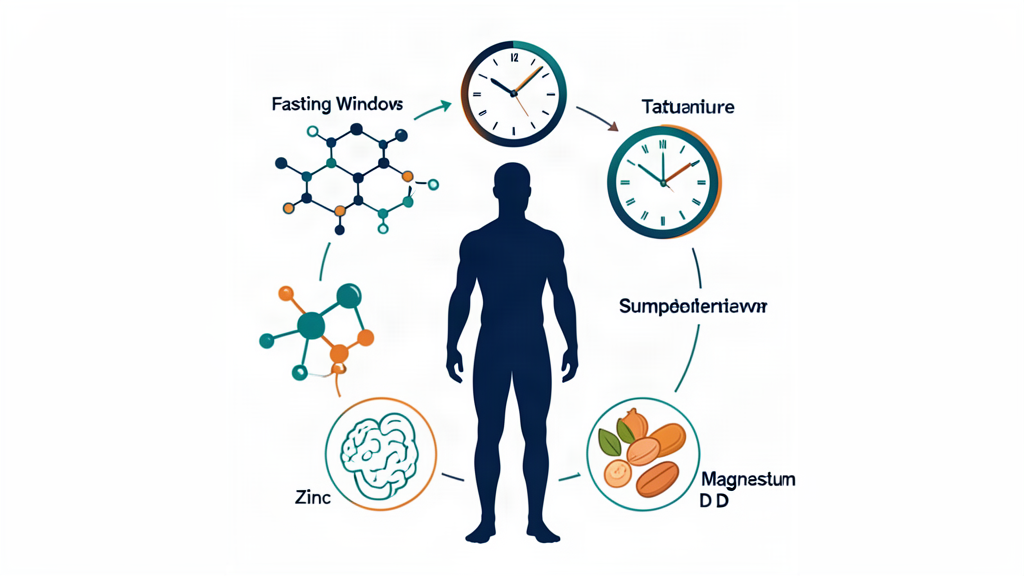
Several supplements have research backing for supporting testosterone during fasting. Zinc and magnesium are two of the most well-studied — zinc directly supports testosterone production, while magnesium helps with sleep quality and reduces cortisol. Vitamin D3 is another key player, as deficiency is strongly associated with low testosterone. Ashwagandha has shown promise in reducing cortisol levels, which indirectly supports testosterone by removing a suppressive signal.
Best Supplements to Support Testosterone During Fasting
While no supplement replaces proper nutrition, sleep, and training, these products can help fill the gaps that fasting creates. We’ve selected options that work well during compressed eating windows and won’t break your fast.
ZMA (Zinc, Magnesium, and Vitamin B6)
ZMA is a time-tested combination designed for men who need to support testosterone and recovery. Zinc directly contributes to normal testosterone production, while magnesium supports muscle function and sleep quality. Take ZMA on an empty stomach before bed — it actually works better during a fasted state because absorption isn’t competing with other minerals from food.
Check the best ZMA supplements on Amazon for options that fit your fasting routine.
Ashwagandha (KSM-66)
Ashwagandha is an adaptogenic herb that has shown significant results in reducing cortisol levels — the hormone that directly suppresses testosterone during fasting. KSM-66 is the most clinically studied form, with research showing cortisol reductions of up to 30% in stressed adults. Lower cortisol means less suppression of your HPG axis, which supports healthier testosterone levels during caloric restriction.
Browse KSM-66 ashwagandha supplements on Amazon to find a quality option.
Vitamin D3 + K2
Vitamin D deficiency is epidemic, and it’s strongly linked to low testosterone. A 2011 study found that overweight men who took approximately 3,332 IU of vitamin D daily for a year increased their testosterone levels by roughly 20%. Vitamin D3 works best when paired with K2, which ensures proper calcium metabolism. Since vitamin D is fat-soluble, take it with a meal during your eating window for maximum absorption.
Find quality vitamin D3 + K2 supplements on Amazon to support your hormonal health.
Omega-3 Fish Oil
Healthy fats are the building blocks of testosterone, and omega-3 fatty acids reduce the chronic inflammation that suppresses the HPG axis. If you’re not eating fatty fish regularly during your eating window, a quality fish oil supplement can help maintain the lipid environment your body needs for optimal hormone production.
Check out high-potency omega-3 fish oil on Amazon for options that support hormonal health.
Frequently Asked Questions
Does fasting increase testosterone?
For most healthy, lean men — no. The 2026 research consistently shows that intermittent fasting lowers testosterone in lean, physically active males, with reductions ranging from 1% to 27% depending on the protocol. However, for obese men, fasting can improve testosterone levels by reducing body fat (which decreases aromatase activity), improving insulin sensitivity, and lowering chronic inflammation.
How much does testosterone drop during intermittent fasting?
The drop depends on your body composition, fasting duration, and overall caloric intake. Simple 16:8 time-restricted eating typically produces modest reductions of 1-5% in lean men. More aggressive protocols like alternate-day fasting or extended 24-48 hour fasts can produce larger drops of 10-27%. The effect is generally reversible — testosterone typically returns to baseline within a few days of resuming normal eating patterns.
Can I fast and still build muscle?
Yes, but it requires strategic planning. During your eating window, consume at least 1.6-2.2 grams of protein per kilogram of body weight. Time your most intense workouts for your fed state, and consider supplementing with creatine and whey protein to support muscle protein synthesis. Our guide on creatine vs BCAAs for fasting covers the evidence in detail.
Which fasting protocol is best for maintaining testosterone?
The 16:8 protocol (eating within an 8-hour window) appears to produce the smallest testosterone disruptions while still delivering metabolic benefits. Avoid back-to-back 24-hour fasts, don’t combine aggressive fasting with intense training, and prioritize sleep and nutrition during your eating window. If you’re overweight, any reasonable fasting protocol will likely improve your testosterone through fat loss.
Do testosterone supplements actually work while fasting?
Some do, with varying levels of evidence. Zinc and magnesium (especially in ZMA form) directly support testosterone production and work well during fasting. Ashwagandha (KSM-66) reduces cortisol, which indirectly supports testosterone by removing a suppressive signal. Vitamin D3 is essential if you’re deficient. However, no supplement can overcome the hormonal effects of severe caloric restriction, poor sleep, or overtraining. Think of supplements as filling gaps, not replacing fundamentals.
The Bottom Line
Fasting and testosterone have a complex relationship that depends entirely on your starting point. If you’re overweight or obese, fasting is likely to improve your testosterone through fat loss and better metabolic health. If you’re already lean, expect modest testosterone reductions — but these are generally temporary and manageable with the right protocol.
The key is choosing a sustainable fasting approach that doesn’t push your body into crisis mode. A 16:8 eating window, adequate protein and healthy fats, quality sleep, and targeted supplementation can help you enjoy the metabolic benefits of fasting without sacrificing your hormonal health. As always, listen to your body and get regular blood work to track your individual response.
As an Amazon Associate, I earn from qualifying purchases.