
Fasting and Growth Hormone: What Science Says in 2026
If you’ve ever wondered whether fasting actually boosts growth hormone — or if it’s just another wellness myth — the science is now clear. A 2025 randomized controlled trial published in Frontiers in Endocrinology confirmed that just 24 hours of water-only fasting can increase human growth hormone (HGH) by 5-fold in men and 14-fold in women, and this increase happens completely independent of weight loss. Here’s what that means for your fasting practice, the mechanisms behind it, and how to optimize your body’s natural HGH response for maximum benefit.
What Growth Hormone Actually Does in Your Body
Human growth hormone, produced by the pituitary gland at the base of your brain, is often associated with childhood development and height growth. But in adults, HGH plays a far more complex and critical role that directly impacts fasting results, body composition, and metabolic health. Understanding what this hormone does helps explain why fasting’s effect on HGH matters so much for anyone practicing intermittent fasting or extended fasting.
HGH stimulates protein synthesis throughout the body, which means it helps your muscles build and maintain lean tissue. This is absolutely critical during fasting because your body needs to preserve muscle while simultaneously burning stored fat for energy. Without adequate HGH during prolonged food restriction, your body could begin breaking down muscle protein for glucose — a process called gluconeogenesis that undermines the very goals most fasters are pursuing. Your body has evolved to prevent this muscle wasting by ramping up HGH production the moment it detects sustained absence of food.
On the flip side, HGH has a catabolic effect on adipose tissue — your body’s fat stores. It breaks down stored triglycerides into free fatty acids, which the liver then converts into ketone bodies like beta-hydroxybutyrate. These ketones become your brain and body’s preferred fuel source during extended fasts, replacing the glucose you’d normally get from food. This metabolic switch from glucose-burning to fat-burning is the foundation of fasting’s effectiveness for fat loss, and HGH is one of the key hormones driving this entire process.
HGH also regulates insulin-like growth factor 1 (IGF-1) and interacts with insulin signaling pathways. In healthy amounts, this supports metabolic flexibility — your body’s ability to seamlessly switch between burning glucose and burning fat depending on what’s available. Research published in Frontiers in Endocrinology found that baseline HGH levels correlated inversely with cardiometabolic risk factors including blood pressure, cholesterol, and glucose concentrations, meaning people with naturally higher HGH tended to have healthier metabolic profiles overall.
For fasters, the practical takeaway is this: HGH is the hormone that tells your body to burn fat and spare muscle during food restriction. The more your body produces during a fast, the more efficiently it can fuel itself from stored energy while keeping your hard-earned muscle mass intact. This is why understanding and optimizing your HGH response matters whether you’re doing 16:8 time-restricted eating or occasional 36-hour fasts.
How Fasting Triggers Massive HGH Increases
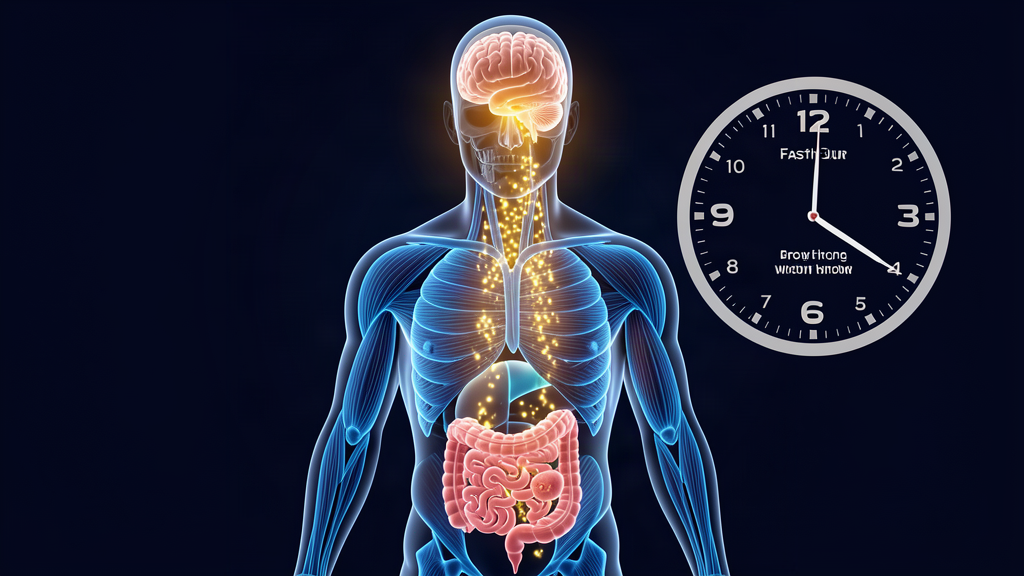
The mechanism behind fasting-induced HGH surges is elegant, well-documented, and directly relevant to anyone practicing intermittent fasting or extended fasting. When you stop eating, insulin levels drop sharply within hours. Low insulin is the primary signal that tells the pituitary gland to release more HGH into the bloodstream. At the same time, ghrelin — the hunger hormone produced by your stomach — rises steadily as your fasting window extends, which further stimulates HGH secretion from the pituitary.
A landmark 2025 randomized controlled trial by Horne and colleagues at Intermountain Medical Center provides the strongest evidence yet for fasting’s effect on growth hormone. The study used a crossover design where 30 healthy adults completed both a 24-hour water-only fast and a 24-hour eating period, with each person serving as their own control. This design is particularly powerful because it eliminates individual variation — the same person’s response during fasting is directly compared to their response during normal eating.
The results were striking and have significant implications for fasting practitioners. Males experienced a 5-fold increase in HGH during the 24-hour fast, while females saw a dramatic 14-fold increase. The difference between sexes is notable — women appeared to mount a significantly stronger HGH response to fasting than men, which may partly explain why some studies show women respond differently to various fasting protocols.
Perhaps the most important finding was that these HGH changes were completely independent of weight loss. The correlation between HGH increase and weight loss was essentially zero (r = 0.01, p = 0.98). This means the HGH surge isn’t a side effect of losing pounds on the scale — it’s a direct physiological response to the fasting state itself. Your body ramps up growth hormone production the moment it detects sustained absence of food, regardless of whether you actually lose weight during that particular fasting period.
The timing matters significantly for people designing their fasting protocols. Earlier research showed that HGH begins rising after approximately 20 hours of fasting and continues to increase with longer durations. A 40-hour fast was shown to increase HGH while simultaneously reducing free IGF-1 and increasing IGFBP-1, suggesting a complex hormonal cascade that extends well beyond a simple HGH spike. This means that the common 16:8 time-restricted eating pattern, while beneficial for many reasons, may not capture the full HGH response that longer fasts provide.
People with lower baseline HGH experienced the largest percentage increases — a median of 1,225% compared to just 50.3% for those with higher baseline levels. This finding is particularly relevant for older adults whose natural HGH production has declined with age, suggesting that fasting may be especially beneficial for this population in terms of hormonal optimization.
What the Research Actually Shows (and What It Doesn’t)
It’s crucial to separate what the science firmly confirms from what remains speculative or overstated in popular wellness circles. The evidence for fasting increasing HGH is robust and well-established — multiple studies across different populations and fasting durations consistently show significant HGH elevation during fasting periods, and this finding has been replicated across research groups worldwide.
What the science clearly supports: Fasting reliably and significantly increases HGH production. The increase is independent of weight loss, meaning it’s a direct fasting response rather than a secondary effect of calorie restriction. HGH plays a direct, documented role in muscle preservation during fasting by stimulating protein synthesis and reducing muscle protein breakdown. HGH also drives fat metabolism during fasting by breaking down stored triglycerides into fatty acids that become ketones. The 2025 Horne study adds that lower baseline HGH is associated with better cardiometabolic outcomes, suggesting HGH dynamics are relevant beyond just body composition changes.
What remains uncertain or requires more research: Whether the transient, pulsatile HGH spikes during intermittent fasting produce the same long-term body composition benefits as sustained elevated HGH from exogenous therapy. Studies of continuous HGH administration in older adults with chronically low IGF-1 showed increased lean body mass by 8.8% and reduced adipose tissue by 14.4% over six months — but those involved constant HGH exposure rather than the brief bursts that fasting produces. The clinical significance of these differences remains an active area of investigation.
There’s also an important nuance about HGH receptors that fasting practitioners should understand. Research in animal models shows that fasting may downregulate HGH receptors in liver tissue, which means not all of HGH’s usual metabolic actions may occur during the fasting state. IGF-1 levels, for instance, were not increased by elevated HGH during 24-hour fasting in the Horne study, confirming previous human data for IGF-1 during 1-5 days of fasting. This suggests that HGH during fasting may have tissue-specific effects that differ from its actions in the fed state, and that the hormonal response to fasting is more complex than simply “more HGH equals more benefits.”
The bottom line from the current body of research: fasting-induced HGH increases are real, significant, and physiologically meaningful. They contribute to muscle preservation, fat mobilization, and metabolic health during fasting. But they’re part of a broader fasting response that includes ketone production, autophagy activation, circadian rhythm improvements, and cardiovascular benefits — not a standalone magic bullet. The most successful fasting practitioners understand HGH as one piece of a larger metabolic puzzle.
How to Optimize Your Growth Hormone Response During Fasting
Based on the current research, here are evidence-based strategies to maximize your body’s natural HGH production during fasting periods:
Extend your fast beyond 20 hours occasionally. While time-restricted eating like 16:8 provides many metabolic benefits, the most dramatic HGH increases documented in research occur after 20+ hours of fasting. Consider incorporating a weekly 24-hour fast or occasional 36-hour fast to capture the full HGH response that the Horne study demonstrated. Even one extended fast per week can provide meaningful HGH elevation beyond what daily 16:8 fasting offers.
Keep insulin as low as possible during your fasting window. HGH and insulin have a powerful inverse relationship — when insulin is elevated, HGH production is suppressed. Avoid anything that significantly spikes insulin during your fast: sugary drinks, fruit juices, cream in coffee (for strict fasts), and even BCAAs which can stimulate insulin secretion. Black coffee, plain water, and zero-calorie electrolytes are safe choices that won’t interfere with the HGH response. The cleaner your fast, the stronger the HGH signal.
Prioritize quality sleep during your eating window. The majority of daily HGH production occurs during deep sleep, particularly during the first few hours of the sleep cycle. Poor sleep quality or insufficient sleep duration can reduce total HGH output by up to 70%. If you’re combining fasting with sleep optimization, you’re essentially doubling down on your body’s natural growth hormone production across both fasting and sleeping states. Consider a quality magnesium supplement like magnesium glycinate, which supports both sleep quality and is commonly used by fasters to prevent electrolyte imbalances during extended fasting periods.
Incorporate high-intensity exercise strategically. Resistance training and high-intensity interval training (HIIT) are among the most potent natural HGH stimulators outside of fasting itself. Combining exercise with fasting creates a synergistic effect — the exercise-induced HGH spike叠加 on top of the fasting-induced increase for a larger total response. However, avoid overtraining during extended fasts, as excessive cortisol production from extreme exercise can blunt the HGH response. Moderate intensity resistance training during a 24-hour fast appears to be the sweet spot based on available evidence.
Maintain adequate protein during eating windows. While fasting increases HGH to preserve muscle, your body still needs amino acids for the protein synthesis that HGH stimulates during refeeding. Focus on complete protein sources during your eating window to support the muscle-building signals that HGH initiates. High-quality protein powders can help ensure you’re getting sufficient amino acids, especially if your eating window is compressed. Collagen supplements can also support the connective tissue benefits that HGH promotes.
Manage stress and cortisol levels. Chronic psychological stress elevates cortisol, which can interfere with optimal HGH production. The relationship between cortisol and fasting is complex — acute fasting may temporarily increase cortisol as a stress response, but this is different from chronic stress. Practice stress management techniques like meditation, deep breathing, or gentle yoga, especially during extended fasting periods when cortisol may already be slightly elevated. Managing cortisol helps create the optimal hormonal environment for HGH production.
Stay hydrated with proper electrolytes. Adequate hydration supports the hormonal cascades that drive HGH production during fasting. During extended fasts, electrolyte balance becomes critical — sodium, potassium, and magnesium all play essential roles in cellular function that support optimal hormone signaling. A quality electrolyte powder designed specifically for fasting can help maintain this balance without breaking your fast or spiking insulin, ensuring your body’s HGH response isn’t compromised by dehydration or mineral imbalances.
Frequently Asked Questions
Does intermittent fasting really increase growth hormone?
Yes, research consistently demonstrates that fasting increases HGH production. A 2025 randomized controlled trial found a 5-fold increase in men and 14-fold increase in women during 24-hour water-only fasts. The effect is well-documented across multiple studies, though the magnitude depends on fasting duration, baseline HGH levels, age, sex, and individual metabolic factors. The key insight is that the increase is independent of weight loss — it’s a direct hormonal response to the fasting state itself.
How long do I need to fast for HGH to increase?
HGH begins rising after approximately 20 hours of fasting, with the most dramatic increases occurring between 24-48 hours of continuous fasting. A 16:8 time-restricted eating pattern may provide some HGH benefits through the overnight fasting period, but the significant spikes documented in clinical research typically require longer fasting periods of 20+ hours. If maximizing HGH is a specific goal, incorporating occasional 24-36 hour fasts into your routine is the most effective approach.
Will fasting HGH help me build muscle?
Fasting-induced HGH primarily helps preserve existing muscle rather than build new muscle. HGH stimulates protein synthesis and spares lean mass during fasting periods, preventing the muscle breakdown that would otherwise occur during food restriction. However, actual muscle growth requires adequate protein intake, sufficient calories, and progressive resistance training during your eating window. Think of fasting HGH as a muscle-protection mechanism that keeps you from losing ground, while your nutrition and training during eating windows determine whether you actually build new muscle.
Is it safe to fast for 24 hours to boost HGH?
For most healthy adults, 24-hour fasts are safe and well-tolerated when properly hydrated with electrolytes. However, certain populations should consult a healthcare provider before attempting extended fasts: people with diabetes (especially Type 1), those with a history of eating disorders, pregnant or breastfeeding women, individuals on blood pressure or blood sugar medications, and anyone with a chronic health condition. Start with shorter fasting periods of 12-16 hours and gradually extend as your body adapts over several weeks.
Can I take HGH supplements instead of fasting?
Exogenous HGH is a prescription medication with significant potential side effects including joint pain, carpal tunnel syndrome, increased insulin resistance, fluid retention, and in some cases increased risk of certain health conditions. The fasting-induced HGH response is a natural, physiologically balanced process that the human body has evolved to handle safely over millennia of food scarcity. Fasting is generally a much safer and more sustainable approach than exogenous HGH for most people seeking the metabolic benefits of increased growth hormone. Always consult a healthcare provider before considering any hormone-based therapies.
As an Amazon Associate, I earn from qualifying purchases.