
You started intermittent fasting for the energy, the mental clarity, the weight loss. What nobody warned you about? Lying awake at 2 AM, staring at the ceiling, wondering why your brain won’t shut off.
Sleep disruption during fasting is one of the most common complaints in fasting communities — and one of the least discussed solutions involves a simple pair of glasses. Blue light blocking glasses have emerged as a surprisingly effective tool for fasters struggling with insomnia, and the science behind why they work during a fast is genuinely compelling.
In this guide, we’ll break down why fasting wrecks your sleep, how blue light blocking glasses address the root cause, and which ones are actually worth buying in 2026. If you’ve been suffering through broken sleep during your fasting windows, this might be the fix you’ve been looking for.
Why Fasting Disrupts Your Sleep
If you’ve noticed your sleep getting worse since you started fasting, you’re not imagining it. There are several physiological reasons why fasting — especially intermittent fasting and extended fasts — interferes with your ability to fall and stay asleep.
Cortisol Rises During Fasting
When you don’t eat for extended periods, your body perceives a mild stress response. Cortisol, your primary stress hormone, naturally increases during fasting as your body mobilizes energy stores. The problem? Cortisol peaks at exactly the wrong time — late evening and early morning — when it should be at its lowest. Elevated cortisol keeps your nervous system in a state of alertness, making it difficult to transition into deep sleep.
Research published in the Journal of Clinical Endocrinology & Metabolism found that fasting for 24 hours or more significantly elevated evening cortisol levels compared to fed states. This effect is more pronounced in people who eat their last meal earlier in the day and have a longer overnight fast.
Blood Sugar Fluctuations
During fasting, your blood sugar drops as glycogen stores deplete. While this is normal and part of the metabolic switch to fat burning, the transition period can cause micro-awakenings throughout the night. Your brain monitors blood glucose levels during sleep, and when they dip too low, it triggers brief arousals that fragment your sleep architecture — even if you don’t fully wake up.
This is particularly common during the first few weeks of intermittent fasting, as your body adapts to new fuel sources. The effect is also more noticeable if you’re combining fasting with low-carb or keto eating.
Adrenaline and Norepinephrine
Fasting triggers the release of catecholamines — adrenaline and norepinephrine — as part of your body’s fight-or-flight response to perceived food scarcity. These hormones increase heart rate, alertness, and mental activation. If you’ve ever felt “wired but tired” during an extended fast, this is why. Your body is chemically preventing sleep to keep you alert enough to find food — an evolutionary survival mechanism that doesn’t serve you well when you’re trying to get 8 hours of rest.
Thermoregulation Changes
Your core body temperature follows a natural circadian rhythm — it drops in the evening to signal sleep onset. Fasting can interfere with this temperature regulation, keeping your body slightly warmer than optimal for sleep. This is why many fasters report feeling restless and overheated at night, especially during extended fasts.
How Blue Light Blocking Glasses Help Fasters Sleep
Here’s where it gets interesting. Blue light blocking glasses address sleep disruption through a mechanism that’s especially powerful during fasting: they protect your circadian rhythm when it’s most vulnerable.
The Circadian Vulnerability During Fasting
When you’re fasting, your circadian clock is already under stress from elevated cortisol, fluctuating blood sugar, and altered hormone patterns. Adding artificial blue light exposure in the evening compounds this stress significantly. Blue light — the wavelengths between 400-495nm emitted by phones, tablets, computers, and LED lighting — suppresses melatonin production by up to 50% according to research from Harvard Medical School.
Melatonin is your body’s primary sleep hormone, and fasting already reduces melatonin production because the amino acid tryptophan (its precursor) is less available when you’re not eating. When you combine reduced tryptophan availability with blue light suppression, you get a perfect storm for insomnia.
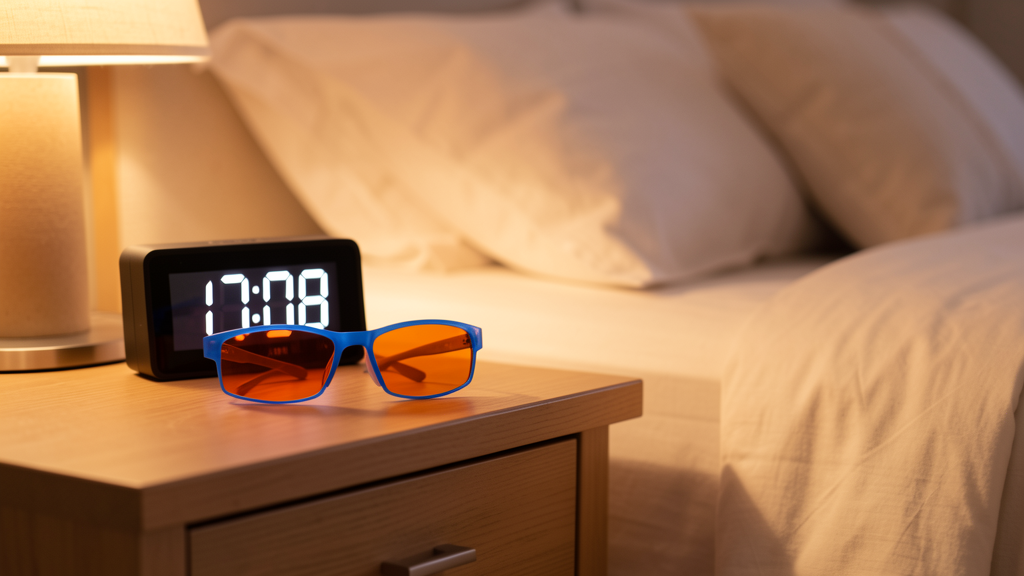
Blue light blocking glasses — specifically those that filter amber and orange wavelengths — prevent this double suppression. They protect the melatonin production pathway that fasting already compromises.
The Cortisol-Blue Light Connection
Research from the Journal of Psychiatric Research showed that blue light exposure in the evening not only suppresses melatonin but also delays the natural evening cortisol decline. Since fasting already elevates evening cortisol, wearing blue light blocking glasses after sunset helps your body complete the cortisol drop that fasting is trying to disrupt.
Multiple fasters in online communities report that wearing amber-lens glasses for 2-3 hours before bed improved their sleep onset time from 45-60 minutes to under 15 minutes — a dramatic improvement that they attribute to protecting their already-stressed circadian system.
Why Standard Sleep Hygiene Isn’t Enough
You’ve probably heard the standard advice: stop screens an hour before bed, keep your room dark, avoid caffeine after noon. For non-fasters, these basics often work. But during fasting, your circadian system is more sensitive and more easily disrupted. Blue light blocking glasses provide an additional layer of protection that standard sleep hygiene alone often can’t deliver.
Think of it this way: fasting weakens your circadian defenses, and blue light is the attacker. Standard sleep hygiene is like closing the windows. Blue light blocking glasses are like adding armor. Both help, but the glasses address the specific vulnerability that fasting creates.
Best Blue Light Blocking Glasses for Fasting Sleep in 2026
Not all blue light blocking glasses are created equal, especially for fasters. The key is finding glasses that block the right wavelengths — specifically amber and orange range (500-600nm) — not just the trendy clear-lens “blue light” glasses that only filter a narrow band.
Best Overall: Uvex Skyper Safety Glasses with SCT-Orange Lens
The Uvex Skyper has become the cult favorite in fasting and biohacking communities, and for good reason. The SCT-Orange lens blocks 98% of blue light and a significant portion of green light — wavelengths that standard “blue light glasses” completely miss. They’re designed as safety glasses, which means they’re durable, lightweight, and have side shields that prevent peripheral light exposure.
At under $15, they’re also absurdly affordable. The orange tint makes them impractical for daytime use, but for 2-3 hours before bed during a fasting window, they’re unmatched. Check price on Amazon →
Best Premium Pick: Ra Optics Daybreak Lenses
If you want something that looks like regular sunglasses and blocks the same wavelengths, Ra Optics is the gold standard. Their amber and orange lenses are prescription-quality optics with 99% blue and green light blocking. They’re popular among biohackers like Andrew Huberman who emphasize circadian rhythm optimization.
The trade-off is price — Ra Optics start around $89. But for fasters who wear their blocking glasses for 3+ hours nightly and want something comfortable enough to forget they’re wearing, the investment pays off in sleep quality. Check price on Amazon →
Best Budget Pick: TOV Blue Light Blocking Glasses
For fasters who want to test the waters without committing to premium lenses, TOV’s orange-lens glasses offer solid 90%+ blue light blocking at a fraction of the cost. They’re available in multiple frame styles and are comfortable enough for extended evening wear. The orange tint is noticeable but not as intense as the Uvex Skyper, making them slightly more socially acceptable if you need to interact with family members before bed.
At around $12-15, they’re a low-risk way to see if blue light blocking improves your fasting sleep before investing in premium options. Check price on Amazon →
Best for Side Sleepers: Sleep ZM Blue Light Blocking Sleep Mask
Some fasters find that even with glasses, ambient light from doorways, hallways, or streetlights still disrupts their sleep. The Sleep ZM combines blue light blocking with a blackout sleep mask design, providing complete light elimination. The built-in blue light filtering means you get protection even if the mask doesn’t form a perfect seal around the nose.
This is particularly useful during extended fasts when sleep disruption is most severe and you need every advantage possible. Check price on Amazon →
How to Use Blue Light Blocking Glasses During a Fast: Practical Tips
Simply owning a pair of blue light blocking glasses isn’t enough — how you use them matters just as much as which pair you buy. Here are practical strategies specifically for fasters:
Timing Is Everything
Put your glasses on 2-3 hours before your target bedtime. This gives your melatonin production time to ramp up before you actually try to sleep. For most people targeting a 10 PM bedtime, that means putting them on around 7-8 PM — right after your eating window closes if you’re doing 16:8 or similar protocols.
The key insight for fasters: your melatonin production is already compromised by the lack of tryptophan from food. Every minute of blue light exposure during the fasting window is disproportionately damaging to your sleep hormones compared to when you’re eating normally.
Combine With Other Fasting Sleep Strategies
Blue light blocking glasses work best as part of a comprehensive approach. Pair them with:
- Magnesium glycinate (200-400mg before bed) — supports melatonin production and relaxes muscles. Magnesium is commonly depleted during fasting through increased urination.
- Electrolyte supplementation — sodium, potassium, and magnesium imbalances during fasting cause restless legs and夜间 awakenings. A quality electrolyte mix before bed can prevent these disruptions.
- Cool room temperature (65-68°F / 18-20°C) — compensates for the thermoregulation changes fasting causes.
- No caffeine after 2 PM — fasting already increases adrenaline; caffeine compounds this effect and has a 6-hour half-life.
Adjust Your Protocol If Sleep Remains Poor
If blue light blocking glasses significantly improve but don’t fully resolve your fasting sleep issues, consider adjusting your fasting window. Moving your eating window later (say, 2-8 PM instead of 12-8 PM) means your body processes food closer to bedtime, providing tryptophan for melatonin production when you need it most. Some fasters find that a small protein-rich snack 2 hours before bed — while technically breaking the fast — dramatically improves sleep quality without undermining their fasting benefits.
The point is that sleep quality matters as much as fasting duration. A 16-hour fast with excellent sleep beats a 20-hour fast with fragmented, poor-quality sleep every time.
Conclusion
Sleep disruption is one of the most frustrating side effects of fasting, but it’s also one of the most treatable. Blue light blocking glasses — specifically amber or orange-lens versions that filter the full spectrum of sleep-disrupting wavelengths — address a root cause that standard sleep hygiene advice misses entirely.
For fasters, the combination of reduced melatonin production (from less tryptophan intake), elevated cortisol (from the fasting stress response), and heightened circadian sensitivity makes blue light protection not just helpful but essential. The Uvex Skyper offers the best value for most fasters, while Ra Optics provides a premium experience for those willing to invest.
Start wearing your blue light blocking glasses 2-3 hours before bed tonight. Within 3-5 days, most fasters report noticeably faster sleep onset and fewer nighttime awakenings. It’s one of the simplest, cheapest, and most effective interventions for fasting-related sleep problems.
As an Amazon Associate, I earn from qualifying purchases.
Frequently Asked Questions
Do blue light blocking glasses actually work for fasting-related insomnia?
Yes, based on both clinical research and extensive community reports. The mechanism is well-established: blue light suppresses melatonin production, and fasting already compromises melatonin synthesis due to reduced tryptophan intake. Blue light blocking glasses protect the melatonin pathway that fasting weakens. Most fasters report improvement within 3-5 days of consistent use, with sleep onset time dropping from 45-60 minutes to under 15 minutes in many cases.
What color lens should I look for in blue light blocking glasses?
For sleep improvement, you want amber or orange lenses — not clear or light yellow. Clear “blue light” lenses marketed for computer use typically block only 10-20% of sleep-disrupting wavelengths. Amber and orange lenses block 90-98% of blue AND green light (500-600nm), which is the range most responsible for melatonin suppression. Look for lenses specifically marketed as “sleep” or “nighttime” blue light blockers.
How long before bed should I wear blue light blocking glasses?
Wear them for 2-3 hours before your target bedtime. This window allows your melatonin production to ramp up without blue light interference. If you go to bed at 10 PM, put your glasses on around 7-8 PM. For fasters, this timing often aligns perfectly with the start of your fasting window — put them on when you stop eating and keep them on until sleep.
Can I just use night mode on my phone instead of wearing glasses?
Night mode and blue light filter apps help, but they’re insufficient on their own — especially during fasting. Phone night modes typically reduce blue light by 40-60%, leaving a significant portion of sleep-disrupting wavelengths active. They also don’t protect you from overhead LED lighting, TV screens, or ambient light from other devices. Blue light blocking glasses provide comprehensive protection from ALL light sources, not just your phone screen.
Will blue light blocking glasses interfere with my fasting benefits?
No. Blue light blocking glasses have zero effect on autophagy, insulin sensitivity, ketone production, or any other fasting benefit. They simply protect your circadian rhythm from artificial light disruption. Many biohackers who practice fasting for longevity consider blue light management an essential complement to their fasting protocol, as sleep quality directly impacts the hormonal environment that fasting aims to optimize.
Related posts:
 Mito Red Light vs Joovv: Best Red Light Therapy for Fasting Recovery in 2026
 Tips For Managing Fasting-related Insomnia And Sleep Disturbances
 How Long Until Autophagy Starts During Fasting? The Complete 2026 Guide
 Ketone Testing During Fasting: Why Your Strips Drop and the Best Ways to Measure Ketosis in 2026
 GLP-1 Drugs and Intermittent Fasting: Can You Combine Them Safely in 2026?