

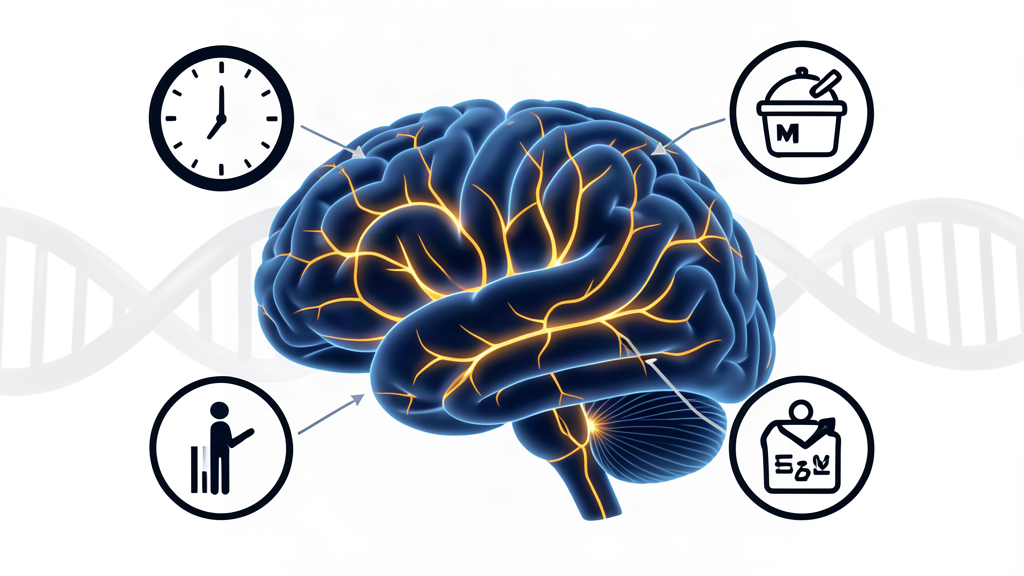
Fasting and Huntington’s: What the 2026 Study Shows
A landmark study published in Nature Metabolism on September 17, 2026, has added powerful new evidence to the growing case that fasting may protect the brain against neurodegenerative disease. The 12-week pilot trial found that time-restricted eating — confining food intake to an 8-hour window — was safe, well tolerated, and associated with favorable clinical outcomes in people with early-stage Huntington’s disease.
For the millions of people who practice intermittent fasting for weight loss, energy, or metabolic health, this research opens an exciting new frontier: fasting as a potential shield against some of the most devastating brain diseases known to medicine. In this article, we break down what the study found, why it matters, and what it means for your fasting practice.
What Is Huntington’s Disease and Why Does It Matter?
Huntington’s disease (HD) is a rare, inherited neurological condition that progressively damages nerve cells in the brain. It affects approximately 3 to 7 per 100,000 people in Western countries, making it less common than Alzheimer’s or Parkinson’s — but its mechanisms of damage are remarkably similar to these more widespread conditions. HD affects movement, cognitive function, and emotional regulation, often described as having Parkinson’s disease, Alzheimer’s disease, and ALS simultaneously. The disease is caused by a mutation in the huntingtin gene, and currently there is no cure.
What makes Huntington’s disease particularly relevant to fasting research is the mechanism of damage. In HD, a misfolded protein called mutant huntingtin accumulates inside neurons, triggering a cascade of cellular dysfunction. The brain’s normal cleanup system — a process called autophagy — fails to clear this toxic protein effectively. Over time, the buildup of damaged proteins and dysfunctional cellular components overwhelms the neuron, leading to progressive cell death. This is where fasting enters the picture.
Autophagy, the cellular recycling process that fasting activates, is one of the body’s most powerful defense mechanisms against protein buildup in the brain. When you fast, your cells shift from growth mode to cleanup mode, breaking down damaged proteins and recycling cellular components. For years, researchers have hypothesized that this process could slow or even prevent neurodegenerative diseases. The 2026 Nature Metabolism study is one of the first to test this hypothesis in humans with a real neurodegenerative condition.
What the 2026 Nature Metabolism Study Found
The study, led by Russell G. Wells and colleagues at Oregon Health & Science University, enrolled 20 individuals with early-stage Huntington’s disease in a 12-week open-label pilot trial registered as NCT06490367. Participants followed an 8-hour time-restricted eating protocol — essentially a 16:8 intermittent fasting schedule where all food consumption occurred within an 8-hour window each day — alongside standard diet and activity recommendations.
The results were striking across multiple measures. First, the protocol was feasible and well tolerated. Participants were able to stick to the 8-hour eating window without significant adverse effects, which is a critical finding for anyone considering fasting with a chronic health condition. Compliance was high throughout the 12-week period, suggesting that time-restricted eating is a practical intervention even for people dealing with the motor and cognitive challenges of early-stage HD.
Second, and more importantly, the researchers observed favorable changes in clinical measures of Huntington’s disease progression. While the specific clinical scores were not fully detailed in the abstract, the direction of change suggested that participants’ condition stabilized or improved slightly over the study period — a meaningful outcome in a disease that typically progresses steadily.
Perhaps the most exciting finding involved plasma neurofilament light levels (NfL). Neurofilament light is a biomarker that indicates nerve cell damage — when neurons are injured or dying, NfL leaks into the bloodstream, making it measurable through a simple blood test. In the study, participants showed changes in NfL levels that suggested reduced neuronal damage over the 12-week period. For context, NfL is increasingly used as a gold-standard biomarker in neurodegenerative disease research, and any intervention that reduces NfL levels is considered highly promising.
While the study was small and lacked a control group — limitations the researchers openly acknowledged — these preliminary results are exactly what the field needed to see. The study was published as a Brief Communication in Nature Metabolism, one of the most prestigious journals in metabolic research, lending significant credibility to the findings. The researchers concluded that their results “support the need for further investigation of TRE as a potential lifestyle intervention in HD.”
How Fasting Protects the Brain: The Science Behind the Headlines
The connection between fasting and brain health isn’t new — but the Huntington’s disease study adds a compelling new layer to decades of preclinical and epidemiological research. Here’s how fasting appears to protect neurons, based on the current scientific understanding:
Autophagy activation. When you fast for 12-16 hours, your cells activate autophagy, the process of breaking down and recycling damaged cellular components. In neurodegenerative diseases, toxic proteins accumulate because autophagy can’t keep up with the rate of protein damage. Fasting essentially gives your brain’s cleanup crew a boost, helping clear the misfolded proteins that cause damage in conditions like Huntington’s, Alzheimer’s, and Parkinson’s. A 2024 review in Translational Neurodegeneration specifically examined dietary fasting and time-restricted eating in Huntington’s disease, concluding that TRE “may hold promise in the treatment of neurodegenerative diseases” through autophagy-related mechanisms.
Reduced inflammation. Chronic neuroinflammation is a hallmark of Huntington’s disease and many other brain conditions. Activated microglia — the brain’s immune cells — release inflammatory molecules that damage surrounding neurons, creating a vicious cycle of inflammation and cell death. Intermittent fasting has been shown to reduce inflammatory markers throughout the body, including in the brain. Studies show that fasting reduces levels of TNF-alpha, IL-6, and other pro-inflammatory cytokines that contribute to neurodegeneration. By lowering the inflammatory burden, fasting may slow the progressive damage that characterizes neurodegenerative diseases.
Improved metabolic flexibility. The brain is an energy-hungry organ, consuming roughly 20% of the body’s total energy despite making up only 2% of body weight. Metabolic dysfunction plays a role in virtually all neurodegenerative diseases — when neurons can’t efficiently produce or use energy, they become vulnerable to damage. When you fast, your body becomes better at switching between glucose and ketones for fuel. Ketones, particularly beta-hydroxybutyrate (BHB), are a cleaner-burning fuel source for neurons and have been shown to reduce oxidative stress in brain cells. For people with HD, where energy metabolism in the brain is impaired, this metabolic switching may provide a critical lifeline.
BDNF production. Fasting increases brain-derived neurotrophic factor (BDNF), a protein that supports the growth, survival, and plasticity of neurons. BDNF is sometimes called “miracle-gro for the brain” because of its role in promoting neurogenesis and protecting existing neurons from damage. Higher BDNF levels are associated with better cognitive function, improved memory, and protection against age-related cognitive decline. In Huntington’s disease, where BDNF levels are typically reduced, fasting-induced BDNF increases could help compensate for this deficit and support remaining healthy neurons.
Enhanced proteostasis. Beyond autophagy broadly, fasting activates specific pathways that help maintain protein quality control — a process called proteostasis. The unfolded protein response (UPR) and the proteasome system both become more active during fasting, helping cells manage the burden of misfolded proteins. In Huntington’s disease, where mutant huntingtin forms toxic aggregates, enhanced proteostasis could help prevent the initial protein misfolding or加速 the clearance of aggregates before they reach toxic levels.
These mechanisms aren’t just theoretical. Previous animal studies showed that time-restricted eating extended lifespan and improved motor function in mouse models of Huntington’s disease. A 2024 study published in Translational Neurodegeneration reviewed the therapeutic potential of dietary fasting in HD, noting that TRE “may hold promise” through multiple overlapping mechanisms. The 2026 human study translates these preclinical findings into real-world clinical data for the first time.
What This Means for Fasting Practitioners
If you practice intermittent fasting, the Huntington’s disease study is encouraging news — but it comes with important caveats that every faster should understand.
The study was small and preliminary. With only 20 participants and no control group, the results are hypothesis-generating, not definitive. Larger, randomized controlled trials with hundreds of participants are needed before anyone should consider fasting as a treatment for neurodegenerative disease. The researchers themselves emphasized that their findings “support the need for further investigation” — not that fasting is a proven therapy.
The benefits extend beyond disease treatment. Even if you don’t have Huntington’s disease, the mechanisms activated by fasting — autophagy, reduced inflammation, improved metabolic flexibility, and increased BDNF — benefit everyone’s brain health. The same cellular cleanup processes that may help clear mutant huntingtin protein also help clear the normal wear and tear that accumulates in all our brains as we age. Think of it as preventive maintenance for your neurons.
Consistency matters more than duration. The study used an 8-hour eating window, which is one of the most common intermittent fasting schedules (16:8). This isn’t an extreme protocol — it’s the same schedule many people already follow. The key was that participants maintained it consistently over 12 weeks. If you’re already doing 16:8 fasting, you’re likely activating many of the same neuroprotective pathways. The research suggests that regularity — showing up every day with a consistent eating window — matters more than pushing for longer fasts occasionally.
The timing of your eating window may matter. Some research suggests that aligning your eating window with daylight hours — eating earlier in the day and fasting in the evening — may provide additional metabolic benefits. While the Huntington’s study didn’t specifically address eating window timing, chrononutrition research indicates that our circadian rhythms influence how we process food and activate cellular repair processes. If you’re optimizing for brain health, consider shifting your 8-hour window to earlier in the day.
Consult your doctor first. If you have a neurodegenerative condition or are at risk, don’t start fasting without medical supervision. The study showed that TRE was safe for people with early-stage HD, but everyone’s situation is different. People with certain conditions, such as a history of eating disorders, diabetes on insulin, or other metabolic disorders, may need modifications or should avoid fasting altogether. Talk to your healthcare provider before making significant changes to your eating patterns.
For product recommendations that support a consistent fasting practice, check out our guides to the best fasting timer apps and magnesium supplements for fasting to help you stay on track with your 16:8 schedule.
The Bigger Picture: Fasting and Neurodegenerative Disease Research
The Huntington’s disease pilot study doesn’t exist in isolation. It’s part of a broader wave of research exploring fasting as a intervention for brain diseases. Here’s where the field stands in 2026:
Alzheimer’s disease. Multiple animal studies have shown that intermittent fasting improves cognitive function and reduces amyloid-beta plaques in mouse models of Alzheimer’s. Human observational studies suggest that people who practice regular fasting have lower rates of cognitive decline, though causation hasn’t been established. Clinical trials are ongoing.
Parkinson’s disease. Research on fasting and Parkinson’s is more limited, but preclinical data shows that caloric restriction and time-restricted eating protect dopaminergic neurons — the cells that die in Parkinson’s. A few small human studies have explored fasting-mimicking diets in Parkinson’s patients with mixed but generally positive results.
ALS (amyotrophic lateral sclerosis). Some evidence suggests that fasting may slow ALS progression in animal models, though human data is sparse. The mechanisms — autophagy, reduced inflammation, improved energy metabolism — are relevant to ALS as well.
General cognitive aging. Beyond specific diseases, the fastest-growing area of fasting research is its impact on normal age-related cognitive decline. Large observational studies consistently show that people who practice regular time-restricted eating have better cognitive function in their 60s, 70s, and beyond. While these studies can’t prove causation, the biological mechanisms are well-established.
The Huntington’s disease study is significant because it’s one of the first to move from “fasting might help brain diseases in theory” to “fasting actually showed measurable benefits in patients with a specific neurodegenerative condition.” That’s a critical step in the translation from lab to clinic.
Frequently Asked Questions
Can fasting cure Huntington’s disease?
No. The 2026 study showed that time-restricted eating was associated with favorable changes in clinical measures, but it was a small pilot study without a control group. Fasting is not a cure for Huntington’s disease, and larger clinical trials are needed to determine whether it can slow disease progression. Always work with your medical team for treatment decisions.
How long do I need to fast to get brain benefits?
The study used an 8-hour eating window (16:8 fasting), which is one of the most popular intermittent fasting schedules. Research suggests that autophagy begins to increase after 12-16 hours of fasting, so a 16:8 schedule is generally sufficient to activate the cellular cleanup processes that benefit brain health. Consistency over weeks and months matters more than pushing for longer fasts.
Is intermittent fasting safe for people with neurological conditions?
The Nature Metabolism study found that time-restricted eating was safe and well tolerated in people with early-stage Huntington’s disease. However, this was a specific population under medical supervision. If you have any neurological condition, consult your doctor before starting intermittent fasting. People with certain conditions, such as a history of eating disorders or diabetes on insulin, may need modifications or should avoid fasting altogether.
What other neurodegenerative diseases might fasting help?
Preclinical research has explored fasting and time-restricted eating in models of Alzheimer’s disease, Parkinson’s disease, and ALS. The autophagy-activating and anti-inflammatory mechanisms of fasting are relevant to all these conditions. However, human clinical data is still limited, and most evidence comes from animal studies. The Huntington’s disease pilot study is one of the first to provide human evidence in a specific neurodegenerative condition.
Should I change my fasting schedule based on this research?
If you’re already practicing 16:8 or a similar time-restricted eating schedule, you don’t need to change anything — you’re likely already activating the neuroprotective pathways discussed in this article. The key takeaway is consistency: maintaining a regular fasting schedule over weeks and months appears to be more important than the specific duration of your fast. If you’re not currently fasting and want to start, begin with a gentle 12:12 schedule and gradually work up to 16:8 over several weeks.
The Bottom Line
The September 2026 Nature Metabolism study on fasting and Huntington’s disease is a milestone in fasting research. It’s the first human clinical data showing that time-restricted eating is feasible, safe, and potentially beneficial for people with a neurodegenerative disease. While the results are preliminary and more research is needed, they add to a growing body of evidence that fasting activates powerful protective mechanisms in the brain.
Whether you practice 16:8, OMAD, or any other fasting schedule, the cellular processes activated by fasting — autophagy, reduced inflammation, improved metabolic flexibility, and increased BDNF — are working to protect your brain every day. The Huntington’s disease study simply confirms what fasting researchers have long suspected: when it comes to brain health, when you eat may matter just as much as what you eat.
As research continues and larger trials get underway, we’ll likely see more evidence connecting fasting to brain disease prevention and treatment. For now, the message is clear: maintaining a consistent fasting practice is one of the simplest things you can do to support long-term brain health — and the science is catching up to what fasters have known intuitively for years.
As an Amazon Associate, I earn from qualifying purchases.