
Oura Ring vs Whoop vs Apple Watch for Fasting 2026
The fasting world has quietly become a wearable world. Walk into any gym at 5 a.m. during a 16:8 fast and you will see three kinds of people tracking the same thing: the ring wearers checking their readiness score before coffee, the strap wearers studying an overnight recovery number, and the smartwatch wearers logging a fasted treadmill session before their eating window opens. All three camps swear their device tells them something the others miss.
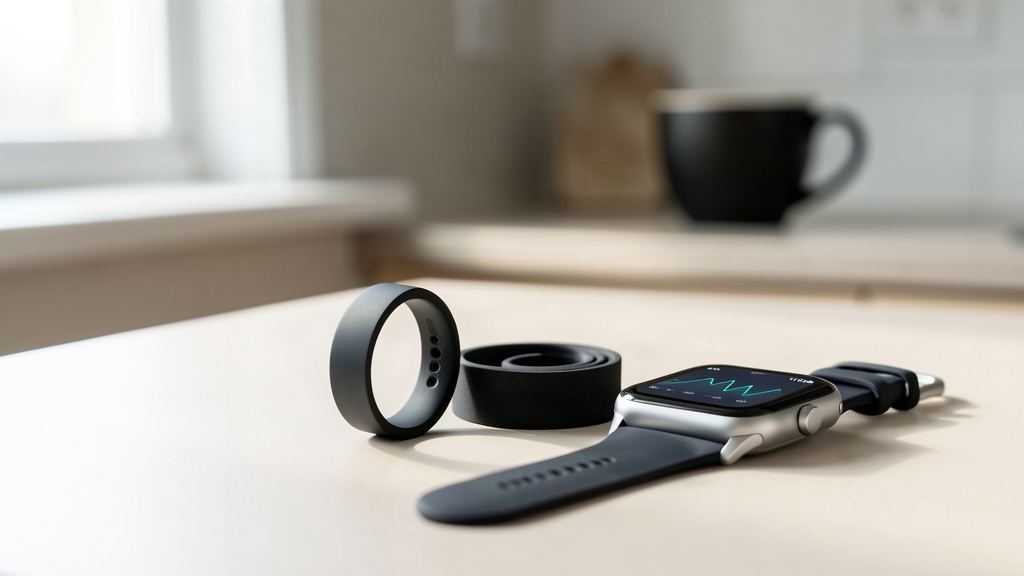
If you are trying to decide which camp to join, the choice has narrowed to three serious contenders in 2026: the Oura Ring 5, the Whoop 5.0 (and its medical-grade MG tier), and the Apple Watch Series 11. Each takes a fundamentally different approach to the same question: what is your body doing while you fast? One is a sleep-first smart ring. One is a screenless recovery strap built around a subscription. One is the most complete health smartwatch ever made. This guide breaks down how each one performs specifically for fasting practices, from overnight fasts to extended water fasts, and tells you which one earns a slot on your body.
Disclosure: As an Amazon Associate, I earn from qualifying purchases. This does not affect our recommendations.
Quick Comparison: Oura Ring 5 vs Whoop 5.0 vs Apple Watch Series 11
| Feature | Oura Ring 5 | Whoop 5.0 | Apple Watch Series 11 |
|---|---|---|---|
| Starting price | $399 | Free hardware with membership | $399 (42mm Wi-Fi) |
| Subscription | $5.99/mo or $69.99/yr | $199-$359/yr (One, Peak, Life) | None |
| Form factor | Smart ring | Screenless strap | Smartwatch with display |
| Battery life | Up to 7 days | Up to 14 days | About 18-24 hours |
| Core fasting strength | Sleep and readiness scoring | HRV recovery coaching | Fasted workout tracking |
| 3-year cost | About $609 | About $597-$1,077 | $399 flat |
Oura Ring 5 for Fasting: The Sleep-First Contender
Oura arrived at its fifth generation in June 2026 with its most refined hardware yet. The Ring 5 is 40 percent smaller than the Ring 4, thinner on the finger, and available in finishes from matte black to deep rose, with prices starting at $399 for black and silver and $499 for premium finishes. Unlike the other two contenders, the hardware is only half the purchase: an Oura membership costs $5.99 per month or $69.99 per year, and without it you lose access to the very features that make the ring useful for fasting.
Those features are genuinely well suited to a fasting practice. Oura tracks your sleep in stages, your nightly heart rate variability, your body temperature trends, and your resting heart rate, then combines them into a daily Readiness score. For a faster, that score is the morning decision tool: a high readiness reading on day three of a calorie-restricted week means you can push a fasted workout; a suppressed reading means the smarter play is a walk and an earlier meal. The Ring 5 also introduced blood pressure trend insights during sleep and refined cycle tracking based on continuous body temperature, and the device is HSA and FSA eligible in the United States, which softens the effective cost for many buyers.
Practical advantages for fasters are hard to overstate. The ring form factor is invisible during sleep, which matters because sleep quality in the back half of an overnight fast is one of the most valuable signals you can collect. Battery life of roughly a week means you are not choosing between charging and collecting data on night four of an extended fast. Water resistance rated to 100 meters means it survives showers, swimming, and the sauna sessions many fasters pair with their protocols. The tradeoffs: there is no GPS, so outdoor run and walk tracking depends on your phone, and the ring is less ideal than a strap for heavy barbell work. The subscription is the real recurring cost. Check current Oura Ring 5 pricing on Amazon if you want to compare finishes before buying direct.
Whoop 5.0 for Fasting: The Recovery Coach
Whoop took an unusual approach in May 2025: the hardware is included when you buy a membership, and the membership is the product. Plans run from Whoop One at $199 per year to Whoop Peak at $239 and the medical-grade Whoop Life at $359, and every plan includes the band itself. There is no screen, no notifications, and no distraction. What you get instead is one number that governs your day: the Recovery score.
Recovery is built from heart rate variability, resting heart rate, and sleep performance, and it is the single most fasting-relevant metric any wearable produces. HRV is one of the first signals to shift when your body is adapting to a new fasting routine or absorbing the stress of an extended fast. A green recovery score on 16:8 says your nervous system is handling the deficit and today is a good day for a hard fasted session. A red score says push the workout to your eating window, or skip it. Whoop pairs that with a Strain coach that tells you how hard to train, a Sleep coach that sets a nightly sleep need based on tomorrow is strain, and a journal that lets you log fasting windows, caffeine, alcohol, and supplement timing, then shows correlations against your recovery over weeks. No other mainstream wearable makes behavioral correlation this painless.
Battery life is the best in this comparison at up to two weeks between charges, and the screenless design has a psychological benefit during fasts: nothing on your wrist is buzzing you about emails at hour fourteen. The tradeoffs are real, though. The subscription never ends, and the base tier lacks GPS, so fasted outdoor walks and runs need your phone along for pace and distance. If you want a display, Whoop is simply the wrong category of device. Since the band ships direct from Whoop, many buyers browse Whoop-compatible bands and accessories on Amazon for aftermarket straps and keepers in the meantime.
Apple Watch Series 11 for Fasting: The All-Rounder
The Apple Watch Series 11 arrived in September 2025 as the slimmest watch Apple has ever built, starting at $399 for the 42mm aluminum Wi-Fi model and $499 for cellular. It is also the only device in this comparison with no subscription at all: every health feature described here is included in the purchase price, forever. That includes sleep apnea detection, hypertension notifications, an ECG app, blood oxygen sensing, sleep scores, and 5G cellular connectivity on compatible models.
For fasters, the Apple Watch wins where the other two concede: movement. If your protocol includes fasted cardio, and the research supporting morning fasted walks keeps growing, the Series 11 is the best tool for the job. Built-in GPS tracks outdoor walks and runs without your phone, the Workout app logs treadmill incline sessions, and the water resistance handles pool swimming between eating windows. Notifications, while useful for life, are the device’s fasting weakness: a buzzing wrist at hour eighteen is one more thing pulling at your attention when willpower is the scarce resource. And the battery is the Achilles heel for sleep tracking. Rated at roughly 18 to 24 hours, the Series 11 usually needs a nightly charge, which means choosing between a full night of sleep data and a full day of workout data. Compare Apple Watch Series 11 prices on Amazon where seasonal sales routinely undercut the $399 list price by $50 to $100.
Winner by Use Case: Which Wearable Fits Your Fasting Style?
Best for sleep-first fasters: Oura Ring 5
If your fasting practice lives or dies by sleep quality, the Oura Ring 5 is the clear winner. A week of battery means you never miss a night to a dead device during an extended fast, the ring is more comfortable in bed than either a strap or a watch, and the Readiness score translates overnight data into a single morning decision. It is the device built for people who treat sleep as the foundation of their fasting results.
Best for recovery-focused training: Whoop 5.0
If you train hard inside your eating window and want a coach that accounts for your fast, Whoop wins. The Recovery score, Strain coach, and journal correlations form the tightest feedback loop between fasting behavior and training performance available in 2026. Two-week battery life removes even the charging excuse.
Best for fasted workouts: Apple Watch Series 11
If the core of your protocol is moving while fasted, whether that is a walking pad session or an incline treadmill routine, the Apple Watch Series 11 is unmatched. On-device GPS, workout modes, and water resistance make it the only contender that is genuinely excellent at exercise, and the absence of a subscription means the $399 is the entire cost.
Best no-subscription option: Apple Watch Series 11
Run the math and the subscription question dominates long-term cost. Three years of Oura ownership runs about $609 including membership. Three years of Whoop Peak runs about $717. Three years with an Apple Watch Series 11 runs $399 flat. If recurring fees are a dealbreaker, the smartwatch wins by default, and it wins on features too.
Best alternative worth considering: Samsung Galaxy Ring
One ring-form-factor alternative deserves a mention for fasters deep in the Samsung ecosystem: the Samsung Galaxy Ring. It delivers sleep, HRV, and activity tracking with no subscription fee at all, which removes Oura’s biggest recurring cost. It pairs most naturally with Samsung phones, and its sensor suite is close to Oura’s for the metrics that matter during a fast. See Samsung Galaxy Ring pricing on Amazon before deciding whether the no-fee tradeoff is worth giving up Oura’s more mature readiness algorithm.
How to Fit Your Wearable Into Your Fasting Schedule
Owning the data is not the same as using it. Three habits turn any of these devices into a genuine fasting tool.
Check readiness before you break your fast, not after. The most valuable reading of the day happens around hour fourteen to sixteen, when your overnight fast has fully expressed itself in HRV and resting heart rate. Make it part of your pre-meal routine: read the score, then decide whether today’s eating window opens with a hard workout and a larger meal, or with gentle movement and a lighter plate.
Watch trends, not single days. HRV commonly dips during the first two to three weeks of a new fasting routine while your nervous system adapts, and it dips again during extended fasts as an expected stress response. A single low-recovery day is noise. A two-week downward slide is information, and it is the wearable signal that most often prevents people from grinding through a fast their body is not handling well.
Pair the wearable with the rest of your stack. Wearable data gets sharper when you combine it with other fasting tools. A dedicated fasting app turns your eating window into a schedule your wearable can be judged against, and if you want to see how glucose responds to the meals that follow your fasts, a continuous glucose monitor adds the metabolic layer no wrist device provides yet. And if sleep tracking is the specific job you are hiring for, our roundup of the best sleep trackers for fasting covers options beyond these three flagships.
Internal links: How to Choose the Best Fasting App in 2026 | How to Use a CGM While Fasting | Best Sleep Trackers for Fasting 2026
Frequently Asked Questions
Does wearing a smart ring or smartwatch break a fast?
No. Wearable devices do not introduce calories, and wearing one has no effect on insulin, ketosis, or autophagy. The only fasting-related consideration is comfort: during extended fasts, some people find that snug straps and rings feel more noticeable as fluid balance shifts, so fit adjustments in week two are common and normal.
Which wearable is most accurate for HRV during fasting?
For overnight HRV, both the Oura Ring 5 and Whoop 5.0 produce research-grade nighttime readings because the measurement conditions, lying still during sleep, are identical night after night. The Apple Watch can measure HRV but prompts you to take readings at inconsistent moments, which makes trend lines noisier. For fasting-specific HRV trends, ring and strap have the edge.
Is the Oura membership worth it for fasting?
For most fasters, yes, with one caveat: without the membership the ring’s headline features, including Readiness, detailed sleep staging, and HRV trends, are locked. At $69.99 per year the membership costs less than a single month of most coaching programs, and it is the part of the purchase you actually use daily. If paying for hardware and then paying again monthly bothers you, the no-subscription alternatives above exist for exactly that reason.
Do I need a wearable to fast successfully?
No. Millions of people fast successfully with a kitchen clock and a notepad. What a wearable adds is troubleshooting precision: when energy crashes, poor sleep, or stalled progress appear, the HRV and sleep data show whether the problem is the fast itself, training load, or something as simple as late caffeine. Devices do not make the protocol work, but they shorten the time it takes to fix a protocol that is not working.
Can I switch wearables mid-fast or mid-year?
Yes, and the transition is painless. Every major platform exports historical data to Apple Health or Google Fit, so your HRV and sleep baselines carry over. The one caveat is that readiness and recovery scores are proprietary algorithms: an Oura readiness number and a Whoop recovery number measure related but not identical things, so expect two to four weeks of parallel readings before the new device’s trends feel trustworthy.
The Bottom Line
There is no single winner here, only the right match for your fasting style. The Oura Ring 5 is the choice for sleep-obsessed fasters who want a week of battery and a morning readiness score. The Whoop 5.0 is the choice for training-focused fasters who want HRV-driven recovery coaching and behavioral correlations. The Apple Watch Series 11 is the choice for fasted-workout devotees who refuse to pay a subscription, and it doubles as the best overall health device of the three. Whatever you pick, the goal is the same: let the data shorten the gap between what your fasting protocol intends and what your body is actually doing. Check the links above for current pricing on Amazon before buying, and pair whichever device you choose with a consistent eating window for the first month, because trends need consistency to mean anything.
Related posts:
 Top 5 Apple Cider Vinegar Supplements for Fasting: Pros and Cons
 Liquid I.V.® Hydration Multiplier® +Kids – Crisp Red Apple Powder Packets Review
 Best Fitness Trackers for Fasting in 2026 — 5 Top Picks
 Freestyle Libre 3 vs Dexcom G7 for Fasting: Which CGM Is Best in 2026?
 Best Electrolyte Supplements for Fasting in 2026 — Tested & Ranked