

How to Start a 24-Hour OMAD Fast: Beginner’s Guide
One Meal a Day — OMAD — is the simplest fasting protocol that actually works. You eat one large, nutrient-dense meal within a 1-4 hour window, then fast for the remaining 20-23 hours. No complicated schedules, no calorie counting, no measuring macros to the gram. Just one meal, once a day.
But here’s the thing: most beginners jump in cold turkey and quit within a week because they get the headaches, the brain fog, and the ravenous hunger that comes from not preparing their body first. This guide walks you through exactly how to start a 24-hour OMAD fast safely, what to eat during your meal, which supplements keep you feeling sharp, and the gear that makes the whole process easier.
Whether you’re coming from a standard 16:8 intermittent fasting routine or starting completely fresh, this step-by-step approach will help you build an OMAD habit that sticks.
What Is OMAD and Why Does It Work?
OMAD stands for One Meal a Day. It’s a form of time-restricted eating where you compress all your daily calories into a single meal, typically eaten within a 1-4 hour window. The remaining 20-23 hours are spent fasting — consuming only water, black coffee, or plain tea.
The science behind OMAD is straightforward. When you eat one meal a day, your body spends most of its time in a fasted state, which triggers several metabolic benefits:
- Autophagy activation: After roughly 16-18 hours without food, your cells begin recycling damaged proteins and organelles. This cellular cleanup process, called autophagy, is one of the key reasons people fast for longevity. Research published in Nature Reviews Molecular Cell Biology has linked autophagy to reduced inflammation and improved cellular health.
- Insulin sensitivity improvement: With only one insulin spike per day instead of three or four, your body becomes more efficient at processing glucose. Studies show that time-restricted eating can reduce fasting insulin levels by 20-30% over several weeks.
- Simplified calorie management: It’s genuinely harder to overeat when you only have one meal to work with. Most people naturally eat fewer calories on OMAD without consciously restricting, which leads to gradual fat loss.
- Mental clarity: Many OMAD practitioners report heightened focus and productivity during their fasting hours. The stable blood sugar and ketone production from extended fasting contribute to this “fasted high.”
OMAD is not the same as undereating. The goal is to eat one complete meal that provides all your daily nutrition — protein, healthy fats, complex carbohydrates, fiber, vitamins, and minerals — in a single sitting. Think of it as concentrating your nutrition rather than restricting it.
How to Transition Into OMAD Safely
The biggest mistake beginners make is going from three meals a day straight to OMAD. Your body needs time to adapt. Here’s a phased approach that works:
Week 1-2: Move to 18:6 Fasting
Start by skipping either breakfast or dinner and narrowing your eating window to 6 hours. For example, eat between 12:00 PM and 6:00 PM. This gives your body 18 hours of fasting time, which is enough to start activating autophagy without the shock of a full 24-hour fast.
During this phase, focus on eating two satisfying meals within your window. Don’t try to cut calories — just change when you eat. If you’re hungry outside your window, drink water or black coffee. The hunger waves will pass within 15-20 minutes.
Week 3-4: Narrow to 20:4 (The Warrior Diet)
Once 18:6 feels comfortable, compress your eating window to 4 hours. Eat one main meal and one smaller meal or snack within that window. This is the “Warrior Diet” approach and it’s the natural stepping stone to full OMAD.
At this point, your body is becoming fat-adapted — it’s getting better at burning stored fat for energy between meals. You’ll notice the hunger pangs becoming less intense and less frequent.
Week 5+: Commit to OMAD
Now you’re ready for a true 24-hour OMAD fast. Pick your meal time and stick with it. Most people find dinner the easiest meal to build around because it fits social routines and gives you the entire day to focus without food distractions.
A typical OMAD schedule looks like this:
- 7:00 AM: Wake up, drink water with a pinch of sea salt
- 8:00 AM: Black coffee or green tea (optional)
- 12:00 PM: Herbal tea or sparkling water
- 5:00-7:00 PM: Your one meal
- 7:00 PM – 5:00 PM next day: Fasting window
Pro tip: A quality electrolyte supplement makes this transition dramatically easier. The headaches and fatigue that derail most beginners are almost always caused by electrolyte depletion, not actual hunger.
What to Eat During Your OMAD Meal
Your one meal needs to do the work of three. That doesn’t mean eating until you feel sick — it means choosing foods that are dense in nutrients, protein, and healthy fats so you stay satisfied for the full 24 hours until your next meal.
The OMAD Plate Formula
Aim for this rough breakdown in your single meal:
- Protein (30-40%): 40-60 grams. This is the most important macro for OMAD. Protein keeps you satiated, preserves muscle mass during fasting, and has the highest thermic effect (your body burns more calories digesting protein). Good sources: chicken thighs, salmon, steak, eggs, Greek yogurt.
- Healthy Fats (30-40%): Avocado, olive oil, nuts, butter, fatty fish. Fat provides sustained energy and helps your body absorb fat-soluble vitamins (A, D, E, K). Don’t be afraid of fat on OMAD — it’s your fuel source during the fasting hours.
- Complex Carbohydrates (20-30%): Sweet potatoes, rice, quinoa, vegetables. Carbs aren’t the enemy on OMAD. They replenish glycogen stores and support thyroid function. Just choose complex sources over refined ones.
- Vegetables and Fiber: Fill at least half your plate with vegetables. They provide micronutrients, fiber for gut health, and volume that helps you feel full without excessive calories.
Sample OMAD Meals
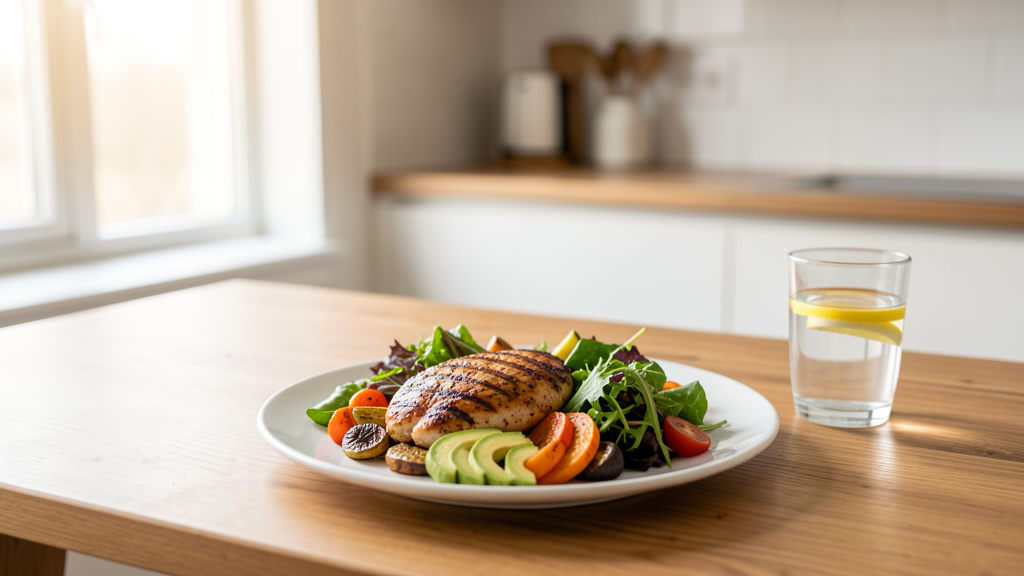
Meal 1 — The Classic: Grilled chicken thighs (6 oz) with roasted sweet potato, a large Caesar salad with avocado, and a handful of mixed nuts for dessert. Total: ~1,200-1,400 calories.
Meal 2 — The Keto OMAD: Salmon fillet (6 oz) pan-seared in butter, steamed broccoli with cheese, a Cobb salad with bacon and blue cheese dressing, and macadamia nuts. Total: ~1,300-1,500 calories.
Meal 3 — The Budget-Friendly: Ground beef stir-fry with mixed vegetables, brown rice, two hard-boiled eggs, and a banana with peanut butter. Total: ~1,100-1,300 calories.
A good digital food scale helps you understand portion sizes during the transition. You don’t need to weigh food forever, but it’s invaluable for learning what a 6-ounce serving of protein actually looks like on your plate.
What to Avoid
- Sugary drinks and fruit juice: These spike your insulin and leave you hungrier an hour later.
- Refined carbs (white bread, pasta, pastries): They digest quickly and won’t keep you full through the fast.
- Excessive fiber supplements: You can overdo fiber in a single meal and cause bloating. Get fiber from whole vegetables instead.
- Alcohol: It disrupts sleep, dehydrates you, and impairs autophagy. Save it for non-OMAD days if you must drink.
Supplements and Gear That Make OMAD Easier
OMAD is simple, but the right tools and supplements remove the friction that causes most people to quit. Here are the essentials:
Must-Have Supplements
Electrolytes are non-negotiable. When you fast for 23 hours, your body flushes sodium, potassium, and magnesium. This is the #1 cause of headaches, fatigue, and muscle cramps in OMAD beginners. A high-quality electrolyte mix without sugar solves this immediately.
We’ve tested dozens of electrolyte brands for fasting. Our top pick for OMAD is LMNT electrolyte drink mix — it has 1,000mg sodium, 200mg potassium, and 60mg magnesium per packet with zero sugar. Drop one in your water during the fasting window and the headaches disappear. For a more budget-friendly option, check our LMNT vs Liquid IV comparison.
Magnesium glycinate before bed supports sleep quality, which is critical during OMAD. Poor sleep increases cortisol and ghrelin (the hunger hormone), making your next fasting day harder.
A high-quality multivitamin fills nutritional gaps, especially if your single meal doesn’t cover all micronutrient bases. Look for one with methylated B vitamins and chelated minerals for better absorption.
Recommended Gear
- Insulated water bottle (32 oz+): Staying hydrated is half the battle on OMAD. A large insulated bottle keeps water cold and serves as a visual reminder to drink throughout the day.
- Glass meal prep containers: If you prep your OMAD meal in advance, glass containers keep food fresh and reheat well. They’re also microwave and dishwasher safe — no plastic chemicals leaching into your food.
- Food scale: As mentioned above, a digital kitchen scale helps you learn proper portions during the first few weeks.
- Magnesium glycinate supplement: Take 200-400mg before bed to improve sleep quality and reduce muscle cramps during fasting hours.
Common OMAD Mistakes and How to Fix Them
Even with the best preparation, you’ll hit some bumps. Here are the most common OMAD mistakes and their fixes:
Mistake 1: Eating too little during your meal. Many beginners undereat because they’re nervous about digesting a large meal. If you’re ravenous by the next morning, you didn’t eat enough. Your OMAD meal should leave you comfortably full — not stuffed, but satisfied. Aim for 1,200-2,000 calories depending on your size and activity level.
Mistake 2: Skipping electrolytes. We can’t say this enough. The single biggest reason people quit OMAD in the first two weeks is dehydration and electrolyte imbalance. Start your electrolyte supplementation on Day 1, not after the headaches start.
Mistake 3: Not sleeping enough. Sleep deprivation amplifies hunger hormones. If you’re only sleeping 5-6 hours, OMAD will feel punishing. Prioritize 7-8 hours of sleep, especially during the first month of adaptation.
Mistake 4: Eating junk food for your one meal. OMAD doesn’t give you a free pass to eat garbage. One meal of fast food won’t kill you, but a daily habit of nutrient-poor food will leave you feeling terrible and deficiencies will pile up. Make your one meal count.
Mistake 5: Training too hard while adapting. High-intensity workouts during your first 2-3 weeks of OMAD can be brutal. Shift to lower-intensity exercise (walking, yoga, light weights) during the adaptation period, then gradually increase intensity as your body adjusts to fueling from stored fat.
When to Break Your OMAD Streak
OMAD isn’t meant to be a permanent daily practice for everyone. Many successful practitioners follow a cyclic approach: OMAD 5 days a week, with 1-2 “feast days” where they eat normally. This prevents metabolic adaptation and gives your body extra nutrition for recovery.
You should also break your OMAD streak if you experience:
- Persistent dizziness or lightheadedness (beyond the first week)
- Significant hair loss (can indicate nutritional deficiency)
- Loss of menstrual cycle in women (sign of hormonal disruption)
- Constant irritability or mood swings that don’t improve after 3-4 weeks
- Inability to eat enough in one meal to meet your caloric needs
Listen to your body. OMAD is a tool, not a punishment. If it’s making your life worse instead of better, adjust the protocol or try a less restrictive fasting schedule like 18:6 or 20:4.
Frequently Asked Questions
Can I drink coffee during my OMAD fast?
Yes. Black coffee with no sugar, cream, or milk is perfectly fine during your fasting window. Coffee actually suppresses appetite and can make the fasting hours easier. Just be aware that caffeine on an empty stomach can cause jitters or anxiety in some people — start with one cup and see how you feel.
How long does it take to adapt to OMAD?
Most people need 2-4 weeks to fully adapt. The first week is the hardest — expect hunger, irritability, and possibly headaches. By week two, hunger waves become less intense. By week three or four, many people report that they don’t feel hungry until their eating window approaches. Full adaptation varies by individual.
Will OMAD cause muscle loss?
Not if you eat enough protein. Consuming 40-60 grams of protein in your single meal, combined with resistance training, preserves muscle mass during OMAD. Studies on time-restricted eating show that lean body mass is maintained when protein intake is adequate. The key is making your meal protein-rich — don’t fill up on carbs and forget the protein.
Can I exercise while doing OMAD?
Yes, but timing matters. Light exercise (walking, yoga, swimming) can be done anytime. For strength training or high-intensity workouts, schedule them 1-2 hours before your meal so you can refuel with protein afterward. Training in a deeply fasted state (20+ hours) is possible but increases the risk of dizziness and reduced performance. Listen to your body and adjust intensity as needed.
Is OMAD safe for women?
Women may need to be more cautious with OMAD than men. Female hormones are more sensitive to caloric restriction, and aggressive fasting can disrupt menstrual cycles. Many women do better with a modified OMAD approach — eating within a 4-6 hour window rather than a strict 1-hour window — or cycling between OMAD and less restrictive fasting days. If you notice changes in your cycle, reduce fasting duration and consult a healthcare provider.
What should I do if I feel dizzy or lightheaded?
This is almost always caused by low blood pressure from dehydration and electrolyte depletion. Immediately drink a glass of water with a pinch of sea salt or an electrolyte packet. If dizziness persists, break your fast with a small meal. Don’t push through severe dizziness — it’s your body telling you something is off.
Final Thoughts
OMAD works because it’s simple. You don’t need apps, trackers, or complicated meal plans. You need one good meal, proper electrolytes, and the patience to let your body adapt over 3-4 weeks.
The beginners who succeed with OMAD are the ones who prepare properly: they transition gradually, they supplement with electrolytes from Day 1, they prioritize protein in their meals, and they don’t beat themselves up when the first week feels hard.
Start with the 18:6 phase this week, work your way to 20:4, and commit to full OMAD once your body is ready. Within a month, you’ll know whether OMAD is right for you — and most people who make it past the adaptation period never look back.
As an Amazon Associate, I earn from qualifying purchases.
Related posts:
 How to Break a 72-Hour Fast Safely: Step-by-Step Guide (2026)
 Transform Your Health with The OMAD Fast: Eat Less, Live Better!
 How to Start Intermittent Fasting: 2026 Beginner Guide
 How to Start 16/8 Intermittent Fasting: A Beginner’s Guide (2026)
 How To Start Fasting: A Beginner’s Step-by-Step Guide